


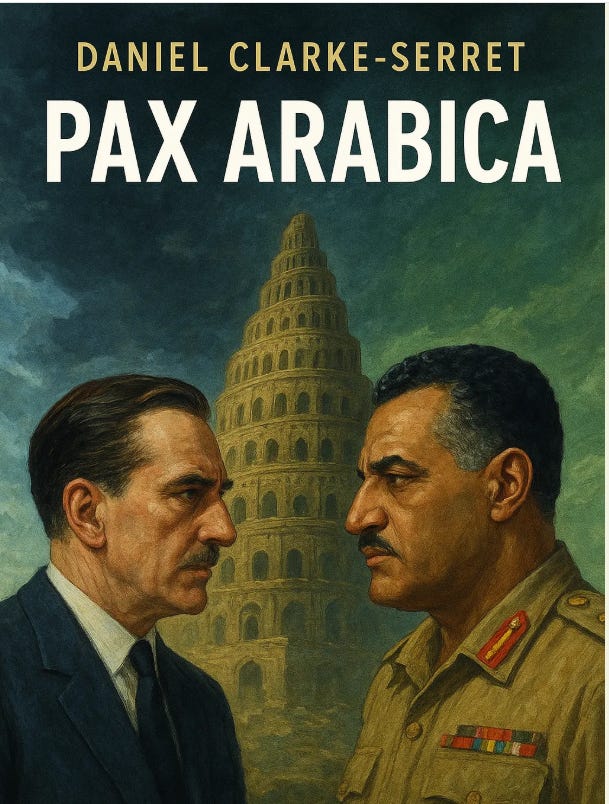
“An important work” (Einat Wilf, The War of Return)
“The book represents writing and thinking of the highest calibre —a testament to intellectual courage. Daniel offers a sweeping and meticulously argued indictment of Arabized Islam as an imperial force. Colonialism has, for too long, been regarded as a uniquely Western sin and something in which only nations engage. Daniel shows that Arabized Islam itself, whether secularized or more overtly religious, is history’s greatest colonial and expansionist force.” (Nachum Kaplan, Moral Clarity)
“In its brutal and brilliant diagnosis, Pax Arabica presents an intellectual framework that is nothing less than a controlled demolition of the West’s entire understanding of the Middle East. It unmasks the Arab Imperium as the region’s true colonial power, deconstructs its sophisticated weapons of narrative warfare, and indicts decades of Western appeasement as the product of moral cowardice and philosophical bankruptcy.” (Khaled Salih, Senior Kurdish Academic and Political Advisor)
“Congratulations to Daniel Clarke-Serret for his Pax Arabica series. Informative, well researched and a really appealing prose style. I’ve found myself quoting passages from the chapters as the topics covered are, as always, very much in the news. Again, well done for such a great work.” (Richard Neat, Observations from the Kitchen)
“There are plenty of ferocious and polemical defenses of Pax Arabica by innumerable apologists for imperialism and terrorism like Edward Said and Rashid Khalidi. A ferocious and polemical response to them is long overdue. In writing one, Clarke-Serret is stronger in history and logic than the apologists, and certainly possesses a moral clarity and historical accuracy they would never dare embrace. More than anything else, however, Clarke-Serret states a simple but too often silent truth: Morality is reciprocity. If the West must face history and itself, so must everybody else. As long as the partisans of Arab imperialism do not, no one in the West is obligated to listen to a single word they say.” (Benjamin Kerstein, Self Defense: A Jewish Manifesto)
“Daniel Clarke-Serret is one of the rare voices who insists on addressing the unwanted, the forgotten and the silenced. In Pax Arabica, he lays all before us—a discovery, a revelation in the truest sense. Truth is unveiled, falsehoods are exposed and lies are uncovered. Only thus can hope be seen clearly, with all its bitterness and all its sweetness.” (Dr Lothar Riemenschneider)
“The Arab Empire is invisible —an insidious entity that can’t be seen with the naked eye. This is the astonishing opening claim of a book which is a must-read. Pax Arabica is a seminal work and one which all readers are strongly encouraged to buy!” (Noah Otte)
“In an existential crisis, such as we are in now, we cannot afford to be blind to what is really going on. As Pax Arabica shows, much of what passes off as conventional ‘wisdom’ about Islam, Palestine, Arab history and colonization is not based on evidence or clear thinking.” (Ashok Panikkar, Ten Lies that Killed Democracy)
“I wanted to extend my sincere congratulations on the publication of Pax Arabica. I have long admired your thoughtful and insightful writings, and am reading, with interest, the wonderful reviews provided by some of the top authorities in the field.
Wishing you great success with this significant achievement.” (Ruth Sheridan)
“If you haven’t read this brilliant book by Daniel Clarke-Serret yet, you’re missing out on important information. Great talking points for dialogue and discussions with people who don’t understand the Middle East and Arab colonization.” (Miller Canning)
“Pax Arabica illuminates the situation in the Middle East ignored by mainstream media and academia. Not only does it delve into the Israel-Palestine conflict, it also explains the minority situations within the Arab and Muslim world.” (Michael Constan)
“Daniel’s breadth of knowledge is impressive. Hoping the book resonates and impacts the powers that be.” (Eli Kavon)
Have you read PAX ARABICA?
Subscribe as PAID today to gain full access to the chapters.
Daniel Clarke-Serret’s PAX ARABICA
Introduction: The time to change the narrative is now!
PART 1: BABEL
Chapter 1: On Arab Imperialism // Chapter 2: On the Vanguard //Chapter 3: On Dictatorial Oppression // Chapter 4: On Islamist “Freedom” // Chapter 5: On Islamist Misery // Chapter 6: On Arab Apartheid // Chapter 7: On Middle Eastern Minorities // Chapter 8: On the Masters of Ethnic Cleansing // Chapter 9: On Genocide, Slavery and Racist Indifference //Chapter 10: On Unjust “Justice” and the Inversion of Language // Chapter 11: On Appeasement // Chapter 12: On the Man who stood against Pax Arabica
PART 2: EDEN
Chapter 13: On Nations, States and the Nation State // Chapter 14: On Sykes-Picot // Chapter 15: On Zionism and the duty to protect // Chapter 16: On the New Regional Sheriff // Chapter 17: On the Psychology of Strength // Chapter 18: On the Paradigm Shift // Chapter 19: On the Post-Imperial Two State Solution // Chapter 20: On the End of the Great Game
AFTERWORD by Khaled Salih: A Song of the Oppressor and the Parody of the Oppressed.
Pax Arabica is a momentous work I’d recommend to everyone! Become a paid subscriber of Guerre and Shalom today to read it in it entirety! Believe me you don’t want to miss a single chapter. Daniel brings to light historical facts long forgotten. Colonialism is a universal human thing it’s not at all exclusive to white people or the West. Everybody is guilty of it. Though I’d say European colonialism was the most humane and progressive form of it. Meanwhile, Arab colonialism was just plain old “I conquered you and now I rule you” colonialism.
Britain set the stage for the United States, Canada, Australia, New Zealand, Israel, Singapore, Botswana, and Belize to become successful states. France improved the lives of Algerians, Moroccans, Syrians, Lebanese, Tunisians, Senegalese, Vietnamese, Laotians, and Cambodians. Germany improved the lives of Tanzanians, Cameroonians and Namibians. Congo would be a lot better off with the Belgians still around and Angola with the Portuguese. I can’t say the same about any country the Arabs conquered be it Spain, the Arabized world or Iran.
No Spaniard’s life was improved by Arab Muslim rule. They were enslaved as a result of it in fact until the great Reconquista rescued Spain. The Moors enslaved white Spaniards without hesitation or any moral qualms. The Jews. Kurds, Druze, Bedouins, Copts, Africans, Maronites, Mandeans, Berbers, Samaritans, and Persians we’re all treated like absolute s*** by the Arabs. This is not to say European colonialism didn’t have its flaws or couldn’t be brutal.
Nor is this to say European colonialism was always practiced in a benevolent way. Take for example, the French colonization of Haiti. That was h*** on Earth! Mad King Leopold II of Belgium killed 200,000 Congolese in the nightmare that was the Congo Free State. Italian rule over Ethiopia and Libya was done with an iron fist and was totally inhumane. The two Opium Wars saw Britain and France wage a brutal war on China so they could takeover parts of the Middle Kingdom and Britain could continue to poison the arteries of China with the drug Opium.
Foreign trade ports in China held by the Europeans and Americans, Russians and Japanese too, operated under the laws of their countries, there was no respect for Chinese culture or religion, foreigners had immunity from being prosecuted by the Chinese authorities if they committed a crime, and Chinese workers slaved hand and foot for the westerners and Japanese who had carved out enclaves on their land. After the Boxer Rebellion was put down the Europeans and their American, Russian and Japanese allies went on an orgy of looting, vandalism, murder, and rape. China was forced to sign a humiliating treaty afterwards.
So believe me, I get that European colonialism wasn’t always a good thing the way it was practiced. But generally speaking European colonialism was kind, benevolent, sought to improve the lives of native people, humane, spread education and the Christian faith, brought new technologies, built much needed infrastructure, introduced them to the ideals of liberal democracy, free-market capitalism, the rule of law, pluralism, human rights, women’s rights, equality for untouchable or marginalized groups, abolished slavery, and created jobs and increased wages and standards of living for the peoples of the third world.
No such benefits came from Arab Muslim rule. Jews and Christians too, were treated as dhimmis. The Arabs enslaved black Africans by the millions. They brutally conquered, Arabized and Islamized their colonial subjects. Their native language and religion was G-O-N-E! The Arabs have slaughtered the Kurds and denied them statehood for decades. Maronites in Lebanon have been murdered, tortured and terrorized by their Muslim countrymen and their PLO allies for all of the late-20th Century. Egypt, Syria and Lebanon were all Christian countries until the Arabs came and wiped that all out. There’s no contest! Give me British, French, Dutch, German, Spanish, or Portuguese Colonialism any day of the week over Arab colonialism!
Want to learn more about non-western colonialism? Here's one of my famous lists of recommended reading:
* The Great Arab Conquests: How the Spread of Islam Changed the World We Live In by Hugh Kennedy
* God's Shadow: Sultan Selim, His Ottoman Empire, and the Making of the Modern World by Alan Mikhail
* The Early Chinese Empire: Qin and Han by Mark Edward Lewis
* Brokers of Empire: Japanese Settler Colonialism in Korea, 1876-1945 by Jun Uchida
* Persians: The Age of Great Kings by Lloyd Llewellyn-Jones
* A New Roman Empire: A History of Byzantium by Anthony Kaldellis
* The Mughal Throne: The Saga of India's Greatest Empire by Abraham Eraly
* Mansu Musa and the Empire of Mali by P. James Oliver
* Empire of the Summer Moon: Quanah Parker and the Rise and Fall of the Comanches, the Most Powerful Indian Tribe in American History by S.C. Gwynne
* Aztec, Inca & Maya Empires: The Illustrated History of the Ancient Peoples of Mesoamerica & South America by Martin J. Dougherty