


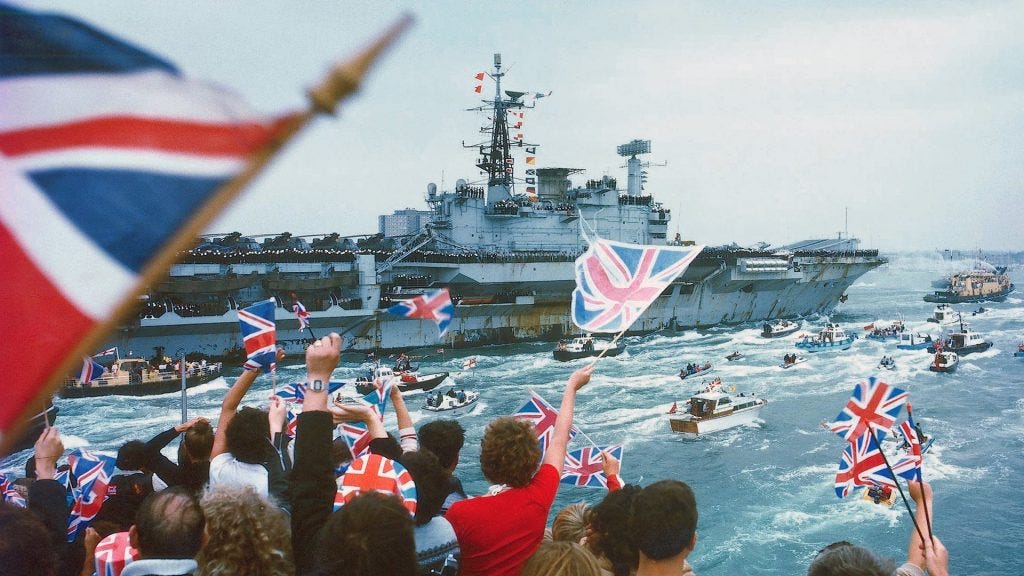
The Syrian fight for Survival
Where does self-determination reside? In the State, in the territory or in the individual? This is the great, unanswered question of international relations and one brought into stark focus by the Falklands War of 1982.
Pax Arabica made the case: Syria has no right to exist, its UN borders being an aberration. With minority persecution an ever present danger, the Druze, Kurds, Christians and Alawites have an unenviable choice. Fight, flee or dominate. The Kurds are fighting, the Christians are fleeing and the Alawites dominated for decades.
None of these options were or are acceptable. As indigenous minorities, they each have the God-given right to live. Self-determination does not lie in the Syrian State nor in a territory arbitrarily guaranteed by the UN Charter. It lies in each and every individual Syrian.
Syrian territory may have been decolonised, but its people still do not self-determine. Instead, it’s an unceasing battleground of the strong against the weak. Either you take up arms or you face extinction –and that inevitable choice will remain until the borders are redrawn or genuine principles of freedom make landfall in Syria.

Falklands: A History of Terra Nullius
We say that self-determination, not inviolable State territory, is the true indicator of freedom. And in the Falklands, even more than in Syria, was this case well made.
The background is simply stated. The Falklands were terra nullius, not in the unconvincing Australian sense, but in a genuine, uncontestable way that defies rebuttal. The islands never had an indigenous population, its lack of natural resources and its far-flung location making that an inevitable result. Thus there was no territory waiting pejoratively to be colonised. As with the Polynesians, who did similar in the South Atlantic, it was finders keepers.
Or better put, it was finders rejectors, for the British weren’t the first to raise the flag on this rocky, no-mans land. The French were en première place to establish a permanent settlement there, but they left due to diplomatic pressure from Spain. Spain’s tenure, brief and historically insignificant, ended soon after, abandoning port in 1811 amidst a collapsing overseas Empire. So when the British arrived in 1833, they were just the latest in a long line of temporary renters. Yet their stay was to achieve permanent tenure, with generations of residents establishing attachment to the land.
The French and Spanish were quick to abandon the islands for richer pickings. And you would have done the same; for with sheep farming its only industry, there was little to attract foreign adventurers. Even the British weren’t overly enthusiastic to maintain their presence. Contrary to urban myths of Iron Ladyship, the Foreign Office, even Thatcher, were more than keen to let the territory go “free”. It was far away, expensive to defend, and for what? A tiny population, an insufficient economy and little geo-strategically to recommend it. Little wonder, therefore, that bribing the islanders was seriously considered. Far less expensive would it be to pay 1 million pounds per person than to continue investing in its defence.
Yet the islanders weren’t for turning. They refused the offer. They refused all offers. An important issue to which we will return.

Battle of the Colonists
First though, let us define the basics. There were no indigenous peoples to colonise —and there was no pre-colonised settlement from which to expel. It was empty. Argentina’s claim, such as it is, is flimsy and rests on two heads.
The first is that “Las Malvinas” are nearby. They are not. Over 500 miles from the coast of a once wealthy South American nation, those rugged rocks, surrounded by wind-swept sea, are in the middle of godforsaken nowhere. In glorious isolation as the British might say. This whole line of Argentine argumentation is pure nationalism, putting (alleged) proximity above the feelings of those that are actually in situe.
The second Malvinasian head is that the Falklands are a colonial relic. Talk about the pot calling the kettle black! For if the Falklands amounts to a colony, then what is Argentina?! Did the natives of that colony speak Spanish? Were their surnames Castro or Sanchez or Martinez? I think not. Unlike the territory in dispute, ancient Argentina was actually occupied, by a real native people in a lush, inhabited land. So if “decolonisation” is the issue, then surely it’s time for the Argentine to return to Spain.
The above stated, we liberate ourselves. We are released to speak of the main issue: not Empire, not decolonisation, not “property”, but self-determination. Where there is no colony, no indigenous population and the old/new claimants are colonists themselves, we are forced to speak of something more important: what the long-settled inhabitants themselves actually want, which in this case is to remain British.
Conditions for Self-Determination
Wanting, in itself, isn’t enough for self-determination. Else with a few magic words, I, or any citizen, could break free. I could divest myself of the social contract and declare my own independent fiefdom. Clarke-Serret-Stan on the Security Council!
So what additional ingredients are needed? As a default, we begin with the UN-recognised borders. Stability has its benefits. If subjects of a State are free to live as equal citizens, then they must remain mute. They may move countries, to be sure, but they may not unilaterally overturn the existing order. The reward for “life, liberty and property” is obedience to the law.
Neither is individual or community will superior to that of the majority, assuming a free, democratic State. The South African white minority may not lord it over the black majority. Their “self-determination” is subject to the right of all to live equally in a free State. Yet this coin has two, never-to-be-forgotten, sides ; for neither may the black minority enslave the white minority. Self-determination assumes that all are equal and all are free, irrespective of their numbers or demographic strength. Syria Sunnis have no right to oppress by dint of numbers.
So, back to the Falklands: here we have a people who wish to be British; to be protected by the British fleet. They oppress no natives, they rule their own land. That in itself is sufficient. Yet, circa 1982, there was a further consideration. Sovereignty of Argentina meant rule by military junta; to be dictated to by purveyors of the most horrendous human rights abuses.
The Argentine people themselves were not free, so how could British subjects hope to self-determine in such a political environment? It reminds me of Syria, of Iraq, of the persecuted minorities of Pax Arabica. They are not free by the mere fact of being independent of France. Domination by dictatorship, especially by those of other ethnic groups that deny equality, is the very antithesis of self-determination.

Appeasement (“diplomacy”) defeated by Argentine intransigence
The interesting thing about the Falklands is the British themselves. Their desire to let the islands go. Their snotty attitude towards resident patriotism. Even as the war neared its climax, negotiations were underway to withdraw from the islands, inevitably leading to some form of Argentine or mixed sovereignty. That it didn’t happen says little about Thatcher’s supposed resolute determination. Rather it is testament to Argentine intransigence. Having rejected approaches from the American Secretary of State, the Peruvians and others, Galtieri continued to avoid compromise. Even with the British at the door of Stanley, he determined to hold on; Hitler’s bunker mentality inspiring another quasi-Fascist.
Falklander self-determination meant little to the British government. With one word of diplomacy from the Junta, they would have capitulated, handing a democratic people to the wolves. Their safety was ignored. Self-determination was brushed aside. Impending extremist rule meant nothing.
Appeasement, once more, presented its absurd attractions. Indeed, had the colonists of Buenos Aires been more strategic, they would of prevailed. Sovereignty would have been theirs as a British Christmas present. Such “negotiations” were close to treachery. Understood that the Falklands are difficult to defend, but doesn’t self-determination trump recolonisation by the Argentine-Spanish?

Freedom!
It is in the Falklands that we see a shadow of the Orient. Diplomacy trumping freedom. Geography trumping self-determination. Free peoples being sacrificed for demographic irrelevance. We even see “human rights” agonising —-over the death of fascistic combatants in acts of war initiated by the targeted party (see the Belgrano).
If self-determination has any meaning left, we must support the liberty of freedom-loving peoples: of Kurds, of the Druze, of the Falklanders. Else we surrender to the mighty in the name of false justice.
Some titles for your reading pleasure to learn more about the Falklands War:
* The Battle for the Falklands by Max Hastings & Simon Jenkins
* The Falklands War by Martin Middlebrook
* The Falklands War 1982 (Essential Histories) by Duncan Anderson
* Across An Angry Sea: The SAS in the Falklands War by Sir Cedric Delves
A terrific article, Daniel on a subject too little discussed! The Falklands War of 1982 is a little remembered and seldom discussed episode in history but one that is most fascinating. It is a classic story of the principal self-determination. The Falkland Islands had no native population. They were deserted until the French arrived and attempted to colonize it. But they were forced out due to diplomatic pressure from the Spanish. The Spanish would end up leaving as well in 1811 due to a collapsing overseas empire. So, when the British settlers arrived in 1833, it was free for the taking. The Islands themselves aren't anything special. Sheep farming is its only industry. For the British government, it far was away, difficult to defend and expensive. Even the British government under Margaret Thatcher wanted to find a way to get rid of it. But the Islanders were resolute that they wanted to stay British. Plus, they absolutely had the right to self-determination as they oppressed no native population and governed themselves. Argentina however, had other plans. They wanted the Falklands for themselves. But their claim to the Islands was complete nonsense. They claimed "Las Malvinas" are nearby. They are nowhere even close! They are 500 miles away in the middle of God forsaken nowhere! Second, they claimed the Falklands were a colonial relic. This is laughable! First off, the Falklands as stated above has no native people, it was deserted like Hawaii was before the Polynesians arrived. Second, this is hypocritical because the whole reason Argentina speaks Spanish and has a mixed population is because of Spanish colonialism. The British government had a snotty, condescending attitude towards the Islanders. So much so, they were negotiating to try and give up the Islands even as the war with Argentina reached its climax. They might well have handed the islands over to the Junta if not for the steely resolve of the Islanders to force them to keep the Falklands and defend it. We must self-determination for all people whether it be the Kurds, Druze, West African Christians, Israeli Jews, or the Falkland Islanders.