


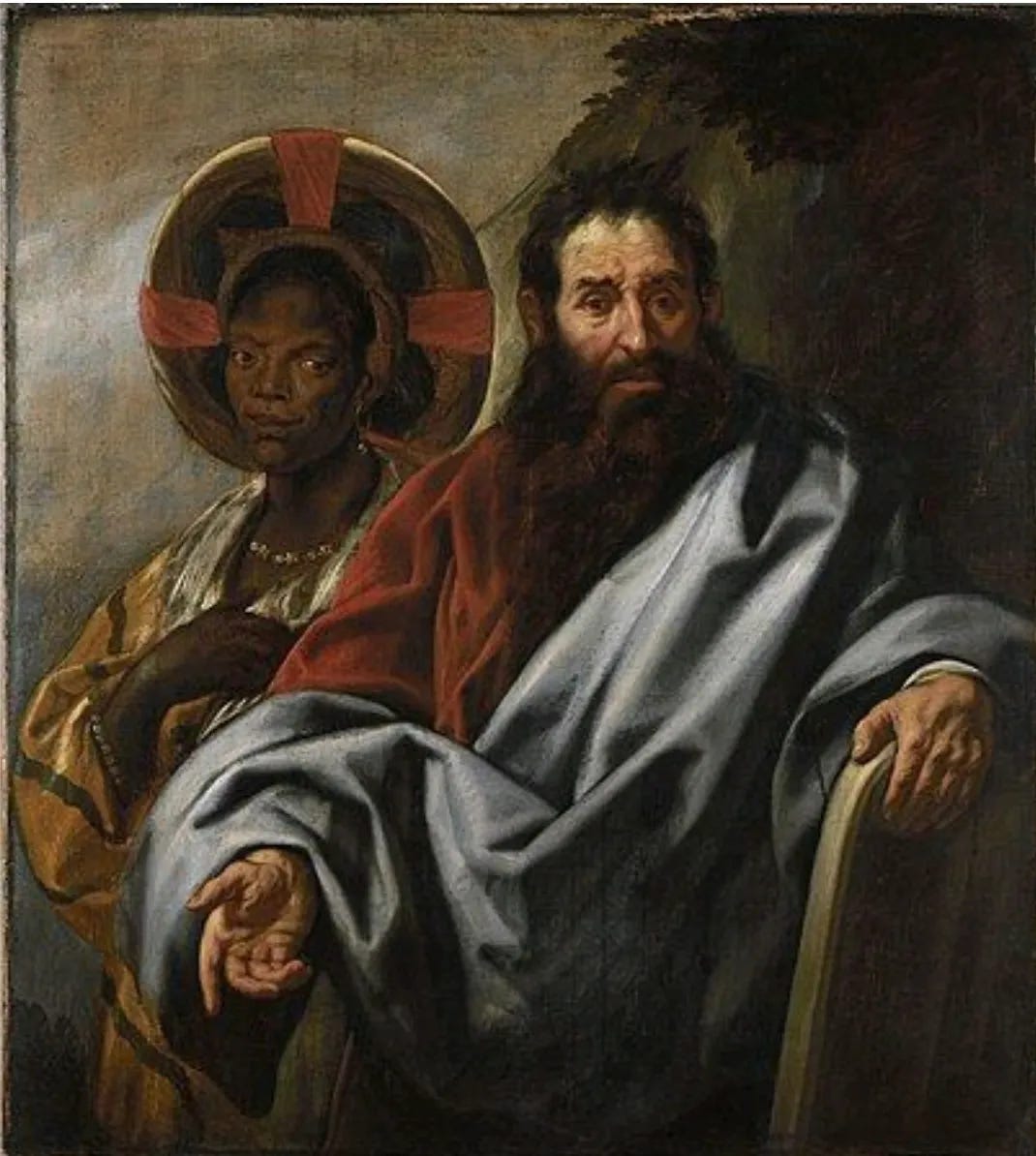
[Image: The painting Moses and his Ethiopian wife Zipporah (in Dutch, Mozes en zijn Ethiopische vrouw Seporah), c. 1645–1650, is a painting by Jacob Jordaens, a Flemish painter.]
EXODUS: THE QUEST FOR FREEDOM
by Daniel A Clarke-Serret
Let me ask out loud what you’re all thinking. What is a non-practicing Jew doing writing about the Torah? What is a man of reason expecting to achieve by engaging with religious texts? And how, by doing so, am I making the change that our world so desperately needs?
Join me on this journey; accompany me on this quest; and the answers will speak back at you as if you personally were standing in the Tent of Meeting in the Wilderness of Sinai. So let us take our leave of Egyptian servitude and venture onwards into the great and courageous uncertainty so excitingly laid out before us.
CONTENTS
PROLOGUE: The Creation of Unity. Putting Humpty Dumpty together again
EXODUS: THE QUEST FOR FREEDOM. A Short Introduction
CHAPTER 1 (Shemot, Exodus 1:1-6:1): Moses, his African Wife & Conversion to Judaism
CHAPTER 2 (Va’eira, 6:2-9:35): Gandhi, the Lancastrians & the Exodus of the Egyptians
CHAPTER 3 (Bo, 10:1-13:16): And so the National Story Begins…
CHAPTER 4 (Beshallach, 13:17-17:16): On Doubt and Anxiety
CHAPTER 5 (Yitro, 18:1-20:23): A Kingdom of Followers
CHAPTER 6 (Mishpatim, 21:1-24:18): The Original “Judicial Coup”
CHAPTER 7 (Terumah, 25:1-27:19): Land of the Free, Home of the Brave
CHAPTER 8 (Tetzaveh, 27:20-30:10): Love Peace and Pursue it
CHAPTER 9 (Ki Tisa, 30:11-34:35): Holding out for a Leader
CHAPTER 10 (Vayakhel-Pekudei, 35:1 - 40:38): Exodus Denied: The Rejection of Freedom
CONCLUSION: Why have I written commentaries on Exodus?
EPILOGUE: A Tribute to Rabbi Jonathan Sacks
PROLOGUE: The Creation of Unity
Putting Humpty Dumpty together again
Three quotes to begin. And please bear with me until the end:
“In the beginning God created (from nothing) the Heaven and the Earth.” (Genesis 1:1)
“If I have seen further it is by standing on the shoulders of Giants”. (Isaac Newton, 1675)
“Humpty Dumpty sat on a wall, Humpty Dumpty had a great fall; All the King’s horses and all the King’s men couldn’t put Humpty together again.” (Traditional English rhyme)
The world is divided by religion, by politics, by ethnicity, by geography, by language and by much more besides. Can it be reunited? Can Babel be reversed? Can Humpty Dumpty be put together again?
I am about to mention the Torah — or as Christians refer to it the “Old Testament”. If the mere mention of religion is enough for you to stop reading, you are - I am afraid to be so direct - part of the problem the world faces today. If you are a “secular” Jew who cannot speak to the other members of your people using our collective references, you are distancing yourself from our national story and you are creating a fissure as much as anyone on the other side of the divide. I am as hostile to theocracy as the next sane person, but mentioning a religious text isn’t theocracy. It isn’t forcing someone to believe in God, to follow certain religious practices or to agree with clerical decrees. And it isn’t establishing the Islamic Republic of Iran in my living room. It is appealing to our common heritage and trying to reconnect our disparate world.
Please allow me to explain and I thank you for your patience. No religious beliefs are necessary to glean the thrust of my argument. All that is needed is a genuine desire to create unity and before that to understand what unity really means. That is what I intend to explore. Whether you literally believe the words in the text of Genesis 1 happened is irrelevant. The 12th Century Jewish sage Maimonides didn’t. I don’t either.
In the quote from Genesis cited above we learn that God created the Heavens and the Earth. For the sake of this prologue, I am going to refuse to engage with the inane debates between the New Athiests and the Creationists about the Big Bang, evolution and whether a Supreme Being created the world in 7 periods of twenty-four hours. Firstly, because I assume that the reader has an IQ above that of a 7 year old. And secondly because the Torah is not a history book. It is a conversation between God and Man. And it is telling us something in these words which is beyond profound. Something which can help us create a world that is complete (SHaLeM). Or to put it another way, a world of peace (SHaLoM).
The Hebrew word for “created” used in Genesis 1:1 is “ba’rah”, the infinitive of which is “liv’roh”. The creation referred to here is ex nihlio or creation from nothing. This is to be distinguished from “l’yatzer” which is creating something new from two or more previously existing elements. To produce. To manufacture. To mix red and blue paint. To create as only a human can. God and Humans may be partners in creation but our creation is “l’yatzer”, not “liv’roh”.
So what did the Almighty create when he “created the Heavens and the Earth”? Everything. Not just the birds, the animals and the flowers. But everything. Probability in Mathematics and the laws of gravity. Love. Respect. Desire. Every concept or idea that has ever been thought or ever will. And He metaphorically made the complete human in one man. Adam. Adam in Hebrew literally means Man. He was the united, complete Man personified.
The world was created perfect. Man was created in unity. Peace reigned eternal. Then everything came apart at the seams culminating in the division of humanity at Babel.
The significance of this point can be released when we stop treating the Torah as a children’s story. Or as a history book. It is a Divine communication with us about the situation we face today and have always faced. We are broken. We are disunited. We are impossibly divided. But we are called upon to put Adam together again. To create the complete man. To create unity. To create peace. But how?
We are called upon to “l’yatzer” (to create). To put together the shards of glass that lie shattered upon the floor and to join them together again piece by piece. We are not called upon to create original ideas. Everything that will ever be created has already been created ex nihilo in that first moment. We must simply combine the disparate ideas that already exist until one day we see the image of Adam looking back at us.
In each generation, we have two obligations. The first is perhaps the hardest. To fight against entropy, To stop the situation getting worse. To put an end to the march of disunity which has been put in motion since the earliest times and only we can stop and reverse.
The second obligation - which I state to you today in the loudest of voices - is to actively reunite the peoples of the world. But this is not the work of supermen. We don’t need to reinvent the wheel. Because great men and women have already begun the task for us and in the words of Newton, we are standing upon the shoulders of giants.
In each of my chapters below and each of my writings elsewhere, I am not being in the least bit original. I am re-creating that which was once said in Eden and has now been forgotten. I am combining the ideas of the giants before me in unexpected ways. I am helping complete the hardest jigsaw puzzle. Yesterday, on my Substack, I may have combined Love Actually, the idea of Britishness, a Palestinian book tour to Jaffa and the Tomb of the Patriarchs in one essay. Today I may have conducted a reunion of Genesis, Isaac Newton and Humpty Dumpty. And tomorrow when the unlikeliest of roommates are speaking together in tranquility under their respective fig trees, the figure of reconstructed Adam will be smiling down upon them.
This is not my task alone. This is our task. And it has been so since the very beginning. So go forth today and “yatzer”!
EXODUS: THE QUEST FOR FREEDOM.
A Short Introduction
There is no greater objective than freedom. The freedom to live under your own fig tree with none to make you afraid. The freedom to act differently to the crowd and according to your own conscience. But though freedom may be easy to say, it is famously hard to define; and even harder to implement in our broken world.
For Jews, the Book of Exodus is the ultimate guide to liberty, a ringing bell that sounds across the land and calls to us through the sands of time. Though the centuries may pass, the imperative to implement this greatest of injunctions grows ever louder.
Every week, the Jewish people read a portion of the Torah in their synagogues and write accompanying articles known as Divrei Torah. These are unique opportunities to engage with the text, to converse with commentators from across the ages and to present to the world your own unique insights. Today it is my turn. You are about to read my reflections on this most famous of books and though they are written in a somewhat unorthodox style, they are a sincere attempt to reflect on the themes of the Holy word and apply them to our current condition as a people and as a wider human family.
For what is the purpose of the Torah and the telos of Jewish thought? Is it to create a closed religious sect? Or is it to spread the word of freedom throughout the nations of the Earth? The Torah knows no religious or secular; It just knows the sincerity of any man or woman who aims to create a better world.
For the information of non-Jewish readers, each chapter in this book has a Hebrew name (Shemot, Va’eira and so on). These are the titles of the various Torah portions from Exodus with the chapters and verses in brackets for your reference.
So with no further ado, let us begin. Let us go on a journey - a life-defining quest - and may we arrive there yonder beyond the horizon as free people. Enlightened and without fear. And in unity of purpose.
It starts - as it always starts - in slavery. In the Land of Egypt. But not all were slaves. One man, his wife and his family lived far from the madding crowd in Midian. That man’s name is Moses. And he has quite a story to tell…
