


Please subscribe as paid to Guerre and Shalom to support our essential, civilisational work, particularly in terms of guarding the fixed meaning and moral import of terms such as genocide and apartheid. Genocide must mean genocide, apartheid must mean apartheid, and murder - from India to America - must mean murder. Our moral compass and societal cohesion depend on it. - Daniel Clarke-Serret (editor, Guerre and Shalom)
On the French riots:

On “Genocide”:


The U.S. has recently dealt with two cases of popular hysteria not against but for a murderer. After Luigi Mangione shot 50-year-old Brian Thompson, father of two, in the back for the crime of being CEO of an insurance company, he gathered a large fan-following, especially amongst young people, and raised more than $1.5 million from 42,000 donors. This support is mostly political because some people think medical insurance providers make money from people’s suffering. Some of the support is based on Mangione’s good looks.
Sympathy for Lindsay Clancy, who strangled her three small children in 2023, is more understandable because she suffered from mental illness and, immediately after the murders, she made a serious attempt to kill herself, which paralysed her below the waist, probably for life. Also, her husband is a dubious character who started dating a year after his children’s murders and remarried three years later. However, this sympathy has swelled into a campaign, mostly by women, for her to be found not guilty on the grounds that postpartum psychosis is a widespread condition. This campaign raised $1.2 million for her defense, and, worse, it has led to vicious online attacks on the juror who held out against an insanity defense.
In India, a similar case occurred recently. Although support for the murderers is much less active, several famous influencers have defended the murderers, and many younger people on social media have agreed with this defense.
26-year-old Ketan Agarwal and 20-year-old Siya Goyal, scions of two prosperous business families in western India, were engaged for four months in 2026. Siya failed Class 12 and, according to her mother, wasn't interested in higher studies and was happy with the engagement. The couple went out on their own during the engagement, and the families say they were in love, which photographs seem to confirm.
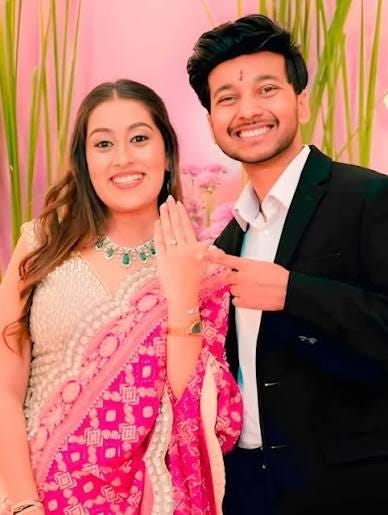
Siya seemed happy. She visited Ketan’s family on her own, and baked cakes for them. She danced with him at various venues and videos show her at night-clubs, dancing and drinking beer. She was not, therefore, a traditional girl who was deprived of agency.
Family-arranged engagements followed by dating and falling in love constitute a common pattern in India. However, such engagements are also often broken off if one partner changes her or his mind.
Meanwhile, it turns out, Siya had also been secretly dating another man, 22-year-old Chetan Chaudhury, for a year. While her fiancé’s family were builders with a net worth of about 600 crore rupees ($62 million USD), her own family was somewhat less prosperous and intended to spend up to 5.5 crore rupees (about $600,000) on the wedding. Her boyfriend, Chetan, however, worked in his family’s grocery business and was lower-middle-class.
Her fiancé Ketan was besotted with the pretty Siya and lent her 1 crore rupees (about $100,000) for wedding shopping, which she gave to her boyfriend Chetan, who used some of it to buy an expensive ring for another girlfriend of his.
On June 18, 2026, Siya insisted on Ketan accompanying her up a steep hill to visit the Lohagad Fort in Pune. There, Siya and Chetan (who arrived on his own) pushed Ketan off a cliff to his death. Later, during interrogation, Siya said she did not like the fact that Ketan was bald and wore a wig (he had told her and her family about this from the start), whereas Chetan had a full head of hair. She had felt that since preparations were in full swing, calling off the wedding would have upset everyone.
Ketan was an only son, and his sister’s suspicions and persistence resulted in the police investigating what appeared to be an accident. During the investigation, Siya and Chetan confessed, and it emerged that on June 14, Siya had taken Ketan up the same hill and tried to push him off, but he had saved himself by grabbing a bush. Siya told Ketan that she had seen a snake and pushed him out of its way.
Also, the couple and their families had planned a pre-wedding trip to Bali, Indonesia, and a photo-shoot there, in early June. At Chetan’s behest, Siya stole and destroyed Ketan’s passport, so the trip had to be cancelled.
Surprisingly, several influencers sprang to Siya’s defense. According to popular pulp-fiction writer Chetan Bhagat, Siya ‘couldn’t say no to marriage.’ (Times of India, June 30, 2026). He added that adults ‘fall in love and date,’ and do not have family-arranged marriages. Both Siya and Ketan’s families belong to a traditional business community, so Bhagat launches a full-scale attack on ‘business families’ as ‘hollow, regressive and shallow,’ claims they are devoid of innovation, and says that they spend their time ‘obsessing over vanity’ by arranging extravagant weddings for their children.
Talk-show host Barkha Dutt and journalist Shobhaa De presented a similar analysis in a video, blaming society’s obsession with marriage for the murder. These two women argued that Siya killed her fiancé because she could not refuse to marry.
What these commentators forget is that first, there have been many cases of men killing girlfriends, therefore marriage is not the cause of murder and, second, that thousands of young people from backgrounds very much like Siya’s say no to marriage every day in India and tell their parents that they are in love with someone else or that they do not want to marry at all. So why couldn’t Siya?
Since Siya failed her high-school exam, her parents tried to marry her into a family that would enable her to continue to live in the style to which she was accustomed. What would they have done if she had told them she did not want to marry Ketan? Would they have murdered her? It seems highly unlikely. They would have been upset because they had already spent a lot of money on the engagement, the wedding venue and so on, but after some fighting, scolding, and weeping, they would have accepted her decision.
Siya was not an old-fashioned rural girl. She dressed as she pleased, went out when she wanted, and drank alcohol. She proclaimed her love for Ketan on social media. She went on extended dates with both Ketan and her boyfriend Chetan.
Siya couldn’t be bothered to talk to her parents because she thought it easier to pass off murder as an accident. There was also a strong financial motive as she would have had to repay the huge loan that she had taken from her fiancé if she had broken off the engagement. Yhe and Chetan would have succeeded in passing off the murder as an accident had it not been for the alertness of the Pune police.
Contra Bhagat, some adults do date and fall in love, but many do not. Many adults, even in the West, welcome help from family and friends.
Also from Ruth:

The fourth-century Kamasutra says that the gandharva vivaha (what is now, in India, called a ‘love marriage’) is the best type of marriage. But a family-arranged marriage is the second-best kind. Plenty of adults have happy family-arranged marriages; some of the happiest marriages I have known have been family-arranged ones. Some so-called ‘love marriages’ (most of which are actually self-arranged marriages) succeed and are happy while others are miserable or end in divorce. Exactly the same is true of family-arranged marriages.
A good life and a good marriage are based on dharma (in the sense of basic values and the law of being human). Dharma does not include killing people just to avoid unpleasantness. Dharma requires telling the truth. In a famous ancient Indian story (Goethe loved the fourth-century Sanskrit play by Kalidasa, based on this story), Shakuntala married King Dushyanta in her father’s absence without his permission, but her father accepted the marriage when he returned.
Many young people today introduce their lovers to their parents, and most parents sooner or later accept and even pay for the weddings. In some instances, mostly rural, parents try to violently separate the lovers and forcibly marry them to other people. Hindu-Muslim marriages often result in violence. But this is far from being the norm. As I document in my book Love’s Rite: Same-Sex Marriage in India and the West, several Indian parents from the ‘80s onward, have accepted and participated in their children’s same-sex weddings.

Commentators who sympathize with Siya want to have it both ways. They agree that murder is wrong but they still want to blame Siya’s parents. It is fashionable to celebrate some communities and castigate others, and it is always fashionable to denigrate the rich. Bhagat seems unaware that most young people in India want, even demand, the most expensive wedding their parents can afford.
Bhagat berates those young people who join their parental businesses and sell ‘steel pipes and rubber wires’ as their fathers and uncles did. Why? Who does he think should sell pipes and wires? Is it all right with him if lawyers’ children become lawyers and doctors’ children become doctors? Or would he like to prohibit children from ever following their parents’ professions or running their parents’ businesses?
Commentators, with boring Puritanism, also tell us that no one should have an expensive wedding. They do not realize that their life-styles and supposedly non-tacky weddings might seem wildly extravagant to their plumbers or to owners of small shops where they buy pipes and wires.
A free society is one in which people can have any kind of wedding they like and marry someone they choose either on their own or with their parents’ and friends’ help.
A free society is one where they can start their own businesses or inherit those of their parents’.
A free society consists of free individuals who have the courage to tell their parents the truth about themselves and do not sneak around in order to cheat on their fiancées as Siya did.
When all is said and done, the truth remains simple: There are no excuses for Siya and Chetan murdering Ketan – none.
A shorter version of this article appeared in The Hindustan Times on July 13, 2026.
For more on this topic, see this article from Mallory Mosner:


👏👏👏 Bravo, Ruth bravo! A smashing article!
Take USD 100K as 0.9 crores. In the article, it is not correct