


Part II has dived into the hell of Jewish decision making from the ancient days of the Northerm Kingdom to pursuit of peace in modern Israel. Today Eli Kavon’s deliberations pass through Yohanan ben Zakkai at Yavne and the American soldier at the gates of Dachau. Faith and doubt, prayer and politics combine in an unforgettable conclusion. Next time: Part III. We meet the Maccabees.
Become a paid subscriber to read all new books from The Guerre and Shalom Publishing House. - Daniel Clarke-Serret (editor)
Jacob’s Voice, Esau’s Hands: A Zionist Polemic
by Eli Kavon
Introduction: The Birth of a Nation
PART 1] Foundations: The Claim of Continuity
Chapter 1: Jacob’s Journey: Evolution of a Patriarch. // Chapter 2: Triumph of the Jewish Polemic // Chapter 3: Reflections on Yerushalmi’s Zakhor
PART 2] Ancient Israel and Judah: The Tragedy of Decision
Chapter 4: The Northern Kingdom Revisited: Beyond Sectarianism // Chapter 5: Ahab: Prisoner of the Text // Chapter 6: An Elegy for Zedekiah // Chapter 7: Gedaliah and The Legacy of Political Murder
Chapter 8: Rabban Yohanan ben Zakkai: Defeatist or Visionary?
Gedaliah was killed for choosing accommodation over resistance. Centuries later, another Jewish leader faced the same choice in the ashes of the Temple itself — and this time, accommodation would be vindicated by two thousand years of history.
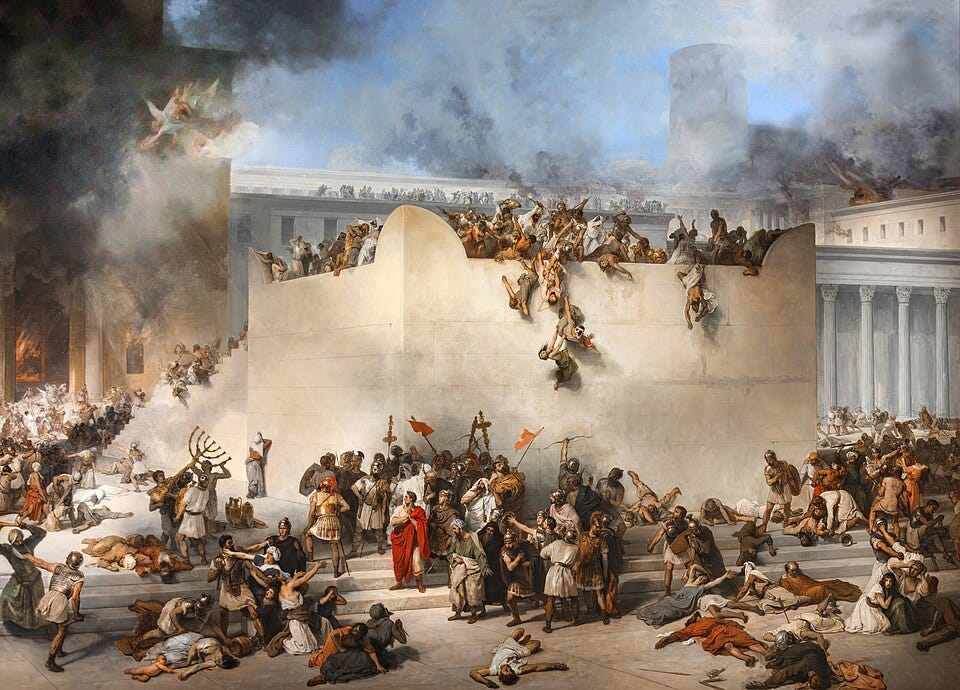
Jewish nationalists have not been very kind to Rabban Yohanan ben Zakkai. The early rabbi’s supposed crime was to surrender to the Romans in the first Jewish revolt against the empire in 66-73 CE. This crime was compounded by the rabbi’s failure to ask the Romans to spare Jerusalem. Instead he requested from General Vespasian a rabbinical center in Yavne, a town seven miles from the Mediterranean, likely an internal exile for those Jews who surrendered to Rome.
Was Rabban Yohanan’s surrendering in 68 CE—two years before the destruction of the Temple observed till this day on the Ninth of Av—the act of a coward or a brilliant strategy to insure the continuity of Judaism and the Jewish people?
By 68 CE, the revolt was heading downhill. This is in stark contrast to the well-organized and partial success of the Bar Kokhba rebellion sixty years later. In this first revolt, the Zealot leadership against Rome was fractured and the rebels fought each other for control. The Romans besieged the holiest Jewish city. They waited for the collapse of the rebels.
Rabban Yohanan must have realized that the situation was hopeless. According to rabbinic sources, Vespasian awarded Yavne as gratitude for Yohanan’s prediction that the general would soon be emperor. Josephus makes the same claim for a prediction and between the two historic sources any debate as to authenticity is futile. But in any case, Rabban Yohanan was to escape Jerusalem in a coffin carried by his disciples.
In the act, he saved Judaism, a fact that the subsequent destruction of Jerusalem and its Temple inscribe into history. Without Yavne and its successors in the Galilee, it is hard to believe that Judaism would have survived the destruction of the Second Temple; for the Temple was the religious, political, economic and social center of the Jews of the ancient Land of Israel. What would replace it?
The claim that Rabban Yohanan could have helped spare Jerusalem is simply ridiculous. The capital city was the nerve center of the resistance and there is no way that the Romans could have been victorious without destroying it. So the Rabbi took a brave and fateful decision. In an act that would change history, he enacted a vision of a different Judaic future.
While this was an early period in rabbinic class and organization, Yohanan envisioned a rabbinate which would one day control Jewish life throughout the Land of Israel and the Diaspora. This was a bold prophecy because, in fact, it took hundreds of years for the rabbis to exert that amount of control.
As for Yavne, rabbinic texts from generations later exaggerate the importance of the coastal town. It is taught that in 80 CE the rabbis canonized the Hebrew Bible. But the reality is that most Jews already accepted the Torah, the Prophets and the Psalms. The arguments at Yavne were the coda to canonization.
In the same vein, prayer replacing sacrifice was not an overnight phenomenon. The Talmud—looking back hundreds of years—presents a dominant and well-organized rabbinate that likely did not exist till the end of the Talmudic period. Formulating halachah (Jewish law)—and having Jews obey it—was to be a lengthy process but one that ultimately succeeded.
Yet it is the vision and decision of Rabban Yohanan that transcends the precise achievements of his Yavne school. He manifested the determination to survive in a world of cutthroat politics.
It is true that surrender is a form of defeat. But, where the enemy is not committed to genocide, the survivors of the surrender have a choice: to live on and continue. While Masada was a figurative and literal dead end, Yavne became the basis of a system that ensured Jewish survival for almost 2000 years.
The tragedy is that the model of surrender and life under a non-Jewish authority collapsed in the last century. The outcome was horrific. And thinking of the creation of the State of Israel, the Yavne template would have ended any Jewish hopes to settle in Eretz Yisrael.
In an era where we are facing worldwide antisemitic violence, Jews from all over the world must find the courage and dignity of those who took their lives on Masada. To continue is impossible in the face of a intended genocide that is more deep and dangerous than anything that the victims of Vespasian had to face. They, at least, had the possibility of surrender.
And so we must not allow the bloodthirsty ambitions of our 20-21st Century adversaries cloud our interpretation of the past. In Recovered Roots: Collective Memory and the Making of Israeli National Tradition (1995), author Yael Zerubavel quotes historian Binyamin Kedar in a way that I wholeheartedly applaud:
“Judaism’s main road does not pass through Masada but in Yavne. Masada is a cul-de-sac, a dead end, a dramatic finale. He who tells the soldiers of the Armored Corps during the Oath ceremony at Masada that ‘thanks to the heroism of the Masada defenders we stand here today’ lives in error and misguides others. If Judaism has survived, if the Jewish people has survived, it is not by virtue of Masada but by the virtue of Yavne; it is not thanks to Eleazar ben Yair, but thanks to ben Zakkai.” (HaAretz)
Chapter 9: Acher and The Difficulties of Teshuvah
Yavne answered the question of how Jewish peoplehood survives catastrophe. It does not answer the harder question of how Jewish faith survives catastrophe — what happens not to the nation but to the individual believer who witnesses horror severe enough to break belief itself. That question is as old as the sages themselves.
The Talmudic tractate Chagigah tells the tale of Rabbi Meir and his teacher Elisha ben Avuyah. Despite his teacher’s abandonment of Judaism and Elisha’s descent into heresy, Rabbi Meir would not abandon his mentor.
