Help us end The Great Genocide Blood Libel today. Sign up as paid to Guerre and Shalom and read/spread this important work.
THE GENOCIDE OF TRUTH: Twenty Roots of a Modern Blood Libel
by Daniel Clarke-Serret
Introduction: The Genocide of Truth
Chapter 1: Truth // Chapter 2: Ideology // Chapter 3: Religion // Chapter 4: Science // Chapter 5: Attention // Chapter 6: Distraction // Chapter 7: (True) Expertise // Chapter 8: Authority // Chapter 9: Declaration // Chapter 10: Confusion
CHAPTER 11: Conversation
Death of the Overton Window
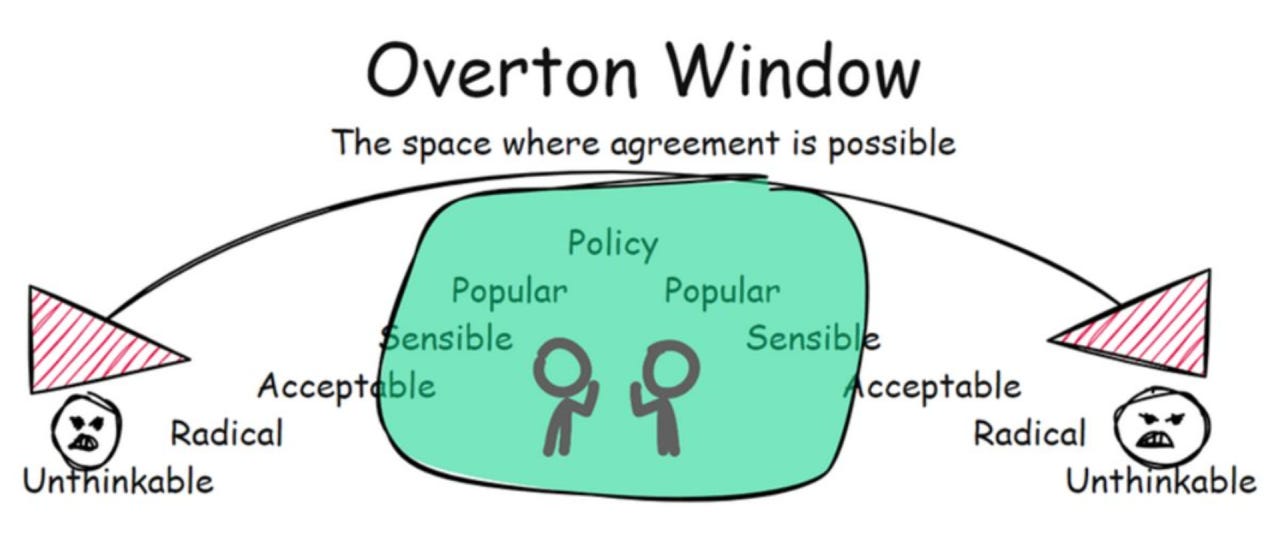
We all believe in free speech – or so we tell ourselves. In reality we believe in a range of acceptable opinions out which speech is politically verboten. Since the 1990s, this space of free expression has been known as the Overton Window.
During the 21st century, and particularly within the last 10 years, the Overton Window has changed dramatically —in terms of what is deemed acceptable, the definitions of Right and Left, and the range of ideas that can be socially aired. Most noticeably of all, we have shifted from a national Overton Window to a factional one.
Where the mainstream Right and Left in the past differed in their views, they shared an Overton Window. Whether you were Labour or Conservative - or the equivalent in your own countries - you had an identical sense of where Extreme Right and Left lay. Thus you could debate openly with your political opponents, come to regular consensus and stonewall the extremes.
An excellent example of this is in the Israeli context is Likud’s attitude to the Extreme Right. In the halcyon days of Yitzhak Shamir, it was Likud policy to boycott Meir Kahane and his political ideas, yet his political son Itamar Ben Gvir is a full member of the current Netanyahu Administration. So whereas the Likud and the Centre-Left once shared an Overton Window, now they live in different political universes.
The effects can be seen beyond Parliamentary politics —in the heart of the mainstream media. When the British largely shared one Overton window, the BBC could genuinely claim to be impartial, if by that one means airing all manner of acceptable political views. Regardless of the staffing of the Corporation, It would be duty bound to showcase voices from both the Left and Right —and it did. Allegations of bias would have had less traction because everyone in political life agreed on the extremes and most accepted that one’s opponent’s views were legitimate.

In the internet age, however, where each man is an Overton Window Island, it is impossible for the BBC (and equivalents) to maintain impartiality. Even if it were genuinely so minded, and even where acting in completely good faith, impartiality is a foreign concept in a world without bounds of acceptability.
So, in the context of the Gaza War, for example, the BBC may claim impartiality through showcasing both Israeli and Hamas voices; but given that Hamas is so far outside the author’s Overton window, it is hard for him to consider the result non-prejudicial. Impartiality doesn’t mean in the middle; it means showcasing the full range of acceptable voices. Where John says Hamas is a terrorist organization and Jane says Israel is committing “genocide”, there are no parameters of acceptable debate — the two cannot share a platform with integrity.
Progressive activists would point to the positive effects of a shifting Overton Window. It was only through the mainstreaming of previously outlandish views that homosexuality became legalized and National Health provision became a reality.
Free Speech enthusiasts would warn of the dangers of defining extremity on high. If a radical views cannot be heard, how can we cast away the shibboleths of the past? How can we move beyond dogma and religious superstition? How can we advance science in the face of clerical opposition? How can we create a better world in the face of “reactionary politics” —or a radicalism that has gone too far?
Surely people need a space to think the unthinkable and say the unsayable?
The above listed arguments have much merit. A world of stifling conformity is a world without change or progress. A world of taboos is a world when neither society nor the individual can grow. But the flaw with unbound progressivism and free speech is that we’re not working together as a unity — as a united nation. There will always be leaders and followers, trendsetters and laggards, but the successful society moves in the manner of an earthworm: the forward section moves on ahead, stretching the animal until the rest follows of its own accord. There is change; there are new ideas; but we move together as a body —a communal spring.
And so it was the British national health provision was not a radical advance by a radical government, but the cumulation of a slowly growing consensus. The Labour party may have dragged the earthworm along, but the Conservative tail followed willingly. Only the “extremist” doctors of the British Medical Association held out against change —ironic one might think.

Similar results were evident in social policy. Wilson’s government may have legislated the previously unthinkable - on homosexuality and much besides - yet they were supported in their efforts by much of the Conservative Parliamentary corpus.
Thus the Earthworm Effect brought about change and progression, all the while maintaining the cohesion of a national Overton Window.
Today, however, we live in a very different world where ne’er the twain shall meet. There is no national, even generational, conversation because we have such different views of what’s acceptable. Badenoch and Corbyn have both been leaders of mainstream political parties in recent times, but their views on Israel, the Middle East and much besides are not just different, but mutually illegitimate. Political debate, of the sort that we saw during the mid-20th Century Consensus, is therefore impossible. Parliamentary contributions have been reduced to mere sloganizing for a Tik-Tok, 1 minute world.
Where there is no common Overton Window - no common conversation - there is no real nation. This is a problem in Britain, Israel and throughout the Western World. Cohesion doesn’t imply agreement, but a recognition of mutual legitimacy. And what brings mutual legitimacy? Living in a shared moral universe buttressed by common terminology.
Incomprehensibility leads to certain contempt and where we hold each other in contempt, there seems no way out of the impasse.
This chapter was first drafted in the milieu of my Substack publication Guerre and Shalom. There, amongst the fluff and foolishness of the internet, free speech is a living and breathing organism. A wide range of views are both encouraged and showcased. It is fair to say that right-wing Benjamin Kerstein and famed liberal feminist Prof Susan Bordo have little in common on a practical policy level. They undoubtedly voted for different candidates in the recent American election — and are both very vocal as regards their political views. Yet they co-exist quite happily in “The World’s Intelligent Journal”. Why? Because each views the other as promoting incorrect, yet legitimate, viewpoints. Neither live in the la-la-land of The Great Genocide Blood Libel. Both - let’s be blunt - are proud Jews.
It is indeed the common rejection of The Great Genocide Blood Libel that makes so many Jews of so very different perspectives live in the same political universe. You don’t need to be an aficionado of Benjamin Netanyahu - I certainly am not - to utterly reject the inversion of language that the human rights establishment characterises as scholarship.
From Dr Khaled Salih to Professor Steven Pinker, we all believe passionately in the truth of words and we mutually rail against the disgraceful linguistic deception of hate-marching New Left. Indeed, it’s remarkable that the always mild-mannered Pinker himself used the expression “blood libel” in terms of the hijacking of genocide memory. But the question, of course, is why reasoned debate is no longer possible within a shared Overton Window. Why is it that Mill’s free speech can no longer swoop in on horseback to save the day? For that we must turn to a theory of knowledge in an act of Cartesian meditation…