


[FOREWORD: To all those who celebrate fRosh Hashana, I wish you Shana Tova, a Happy New Year. To those don’t, have a well-deserved drink. To those who don’t drink, smile broadly. To don’t who don’t smile…oh never mind.
The Jewish New Year has three principle meanings, none of which are to do with having a party. The first is a celebration of the World’s birthday, a happy remembrance of Creation. That’s Nature. The second is a crowning of a meta-physical God as the King of the World. That’s the power of God over Nature. The third is the story of a renowned Mesopotamian, a man who left his land and traditions, and started anew, creating the concept of progress as he went. He subsumed his most profound desires to follow the commands of a God beyond the physical. That’s the power of Man to imitate God and subdue Nature.
Although we acknowledge the thesis of Ashok Panikkar that progress can be destructive, especially when it undermines the very foundations of society, the progressive foundation stones laid by Abraham allowed us the hope of a better tomorrow. In this article, we affirm the good news: There is a future.]
With thanks to recently paid up subscribers:
“Climate change: Revenge of the monotheists” by Daniel Clarke-Serret"
Mother Nature?
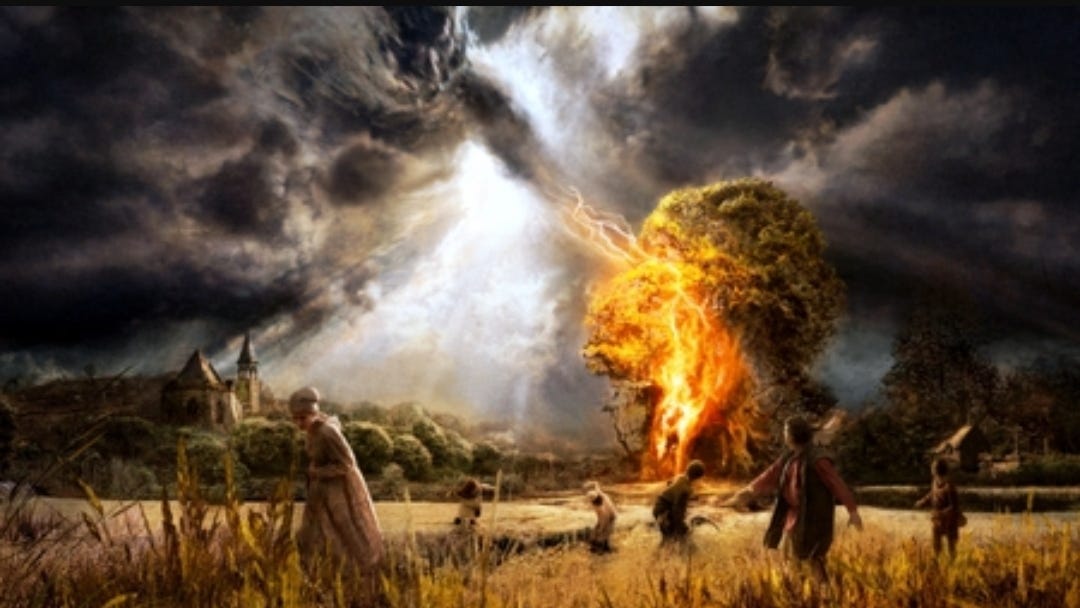
Mother nature. Such a warm, homely phrase. As if we sucked gently at the bosom of hurricanes, whilst rocking on an earthquake-propelled chair next to the warmth of a forest-fireplace. Oh how we romantically think back to those days when we worshiped the rain out of fear that it wouldn't fall and paid tribute to the sea lest it burst its banks and destroy our crops. Behold there was a golden age! An age where we broke our backs in the fields just to eat —and we ate just to break our backs in the fields*.
To have those leisureless days back: what a yearning we all have! To sacrifice our children to Molech in trembling at her revenge; to take the heart of our Aztec offspring to appease a rain-supplying deity. That was the true Enlightment! The truth must be spoken plainly. Nature is no mother. Nor a long-abandoned friend. HE is a vicious enemy that we have subdued after millenia of suffering.
The radical monotheistic answer to tyranny of nature
“Radical Then, Radical Now” declared Jonathan Sacks of the monotheistic enterprise. And Dr Micah Goodman concurs. In ancient times we were slaves to the cycles of nature. Entrapped under its tyrannical whip, we struggled to produce food for sustenance, only to see it destroyed in the latest natural disaster. History didn’t exist. The lives of our parents were carbon copies of those of their parents and ad infinitum until the beginning of “civilised” time. And though humanity had developed (at less than a snail’s pace) through the tortuous stages of stone, bronze and iron and had made the devil’s bargain to take up agriculture, that wasn’t how humans experienced time.
Over the course of the living generations almost nothing had changed and that was how it was destined to remain. Everything that was will be again. Abraham and the ancient characters from Biblical lore were envisaged as medieval knights, unchanged from humanity’s current predicament. This was the (literal) tragedy of cyclical time. Even if one was minded to make a change; even if one were able to reason one’s way to imagine a new order; you would immediately lose hope. For there was no future. All that could conceivably be imagined would end in inevitable disaster.
Both Jonathan Sacks and Micah Goodman in their philosophical writings see monotheism as more than a mere mathematical correction, reducing an Olympia of gods into a single divine entity. It was a radical statement; that we could liberate ourselves from the lived hell of the natural order. As there was once an Exodus from the oppressive economic hierarchy of Pharaonic Egypt, now there could be Exodus from the taskmasters of the wind and the rain. Things that were didn’t have to be. There was a distinction between is and ought to. In the very first statement in Genesis we learn “In the beginning God created the heavens and the Earth”. And therein lies the seed of true radicalism. For if God created nature, ipso facto He wasn’t part of it. The terrifying forces of raging seas and the unyielding skies could be tamed by an outside power.
I speak not of passivity. I speak not of praying to a distant monotheist God more in hope than in judgment. What I speak of is the incredible power entrusted to the human race, For in the Bible declaring that humanity was made “in the image and likeness of God”, we were thereby given the God-like powers to control the forces around us.
At first it was a mere belief. Less a programme for action and more a theoretical acceptance than an overturning of the brutal natural dictatorship could be enacted. Indeed, for centuries after Sinai, organised monotheistic religion was a tool for controlling the masses. Visions of heaven and hell stood over the fearful heart of man no less oppressively that the nature-based gods of the Aztec Empire that drove tear-strewn mothers to take the lives of their beloved progeny. But though the seed was long in growing, grow it did.
Hearing the still, small voice: God is not in nature

[Image: The Jewish tefillin ritual. Renewing your marriage vows to a loving God. A protest against the tyranny of the “gods of nature”]
Before the common era, Elijah cowered under a rock; he believed that God resided in the wide, the rain and storm. Bref, in nature. A natural conclusion for an ancient man. But then he had a moment of epiphany. For the voice of the monotheistic Almighty came in kindly whispered tones. As the Book of Kings recounts (Chapter 19):
“Then a great and powerful wind tore the mountains apart and shattered the rocks before the Lord, but the Lord was not in the wind. After the wind there was an earthquake, but the Lord was not in the earthquake. After the earthquake came a fire, but the Lord was not in the fire. And after the fire came a still, small voice. When Elijah heard it, he pulled his cloak over his face and went out and stood at the mouth of the cave.”
The Prophet Hosea, also of Biblical stock, was called to spread the revolutionary message. God was perceived by the Hebrew masses to be no less fear-inducing that his pagan rivals. The Almighty was seen as a violent, jealous husband. A master. Or in the Hebrew words of scripture a “ba’al”. But Hosea said no. God was no tyrant. He was an “ish”. A husband as partner. A sharer of domestic chores. A bringer of equality. A caring lover. A kindly soul who would love us and accompany us always on the journey of life. Humanity was to be a partner in the work of creation and a powerful agent for change.
In those days, the prophet’s words were scarcely believed. But his vision of a human race liberated from the grip of fear was eventually to come to pass. Chapter 2 of the Book of Hosea sets out a majestic vision of unparalleled beauty:
“Therefore, behold, I will allure her, and bring her into the wilderness, and speak tenderly to her. And there I will give her her vineyards and make the Valley of Achor a door of hope. And there she shall answer as in the days of her youth, as at the time when she came out of the land of Egypt.
And in that day, declares the Lord, you will call me ‘My Husband,’ and no longer will you call me ‘My Baal.’ …. And I will make for them a covenant on that day with the beasts of the field, the birds of the heavens, and the creeping things of the ground. And I will abolish the bow, the sword, and war from the land, and I will make you lie down in safety. And I will betroth you to me forever. I will betroth you to me in righteousness and in justice, in steadfast love and in mercy. I will betroth you to me in faithfulness. And you shall know the Lord.”
And this was the abiding creed of Jewish thought. To this day, religious Jews “marry” the God of love everyday through the act of the laying of tefillin. Upon making the sign of a wedding ring with the black straps of these ritual objects, the observant declare their unshakeable commitment to the loving relationship of the divine union. They do so reciting the prophetic words of Hosea: “I will betroth you to me in righteousness and in justice, in steadfast love and in mercy. I will betroth you to me in faithfulness. And you shall know the Lord.”
Science and technology: Fulfilling the prophecy.
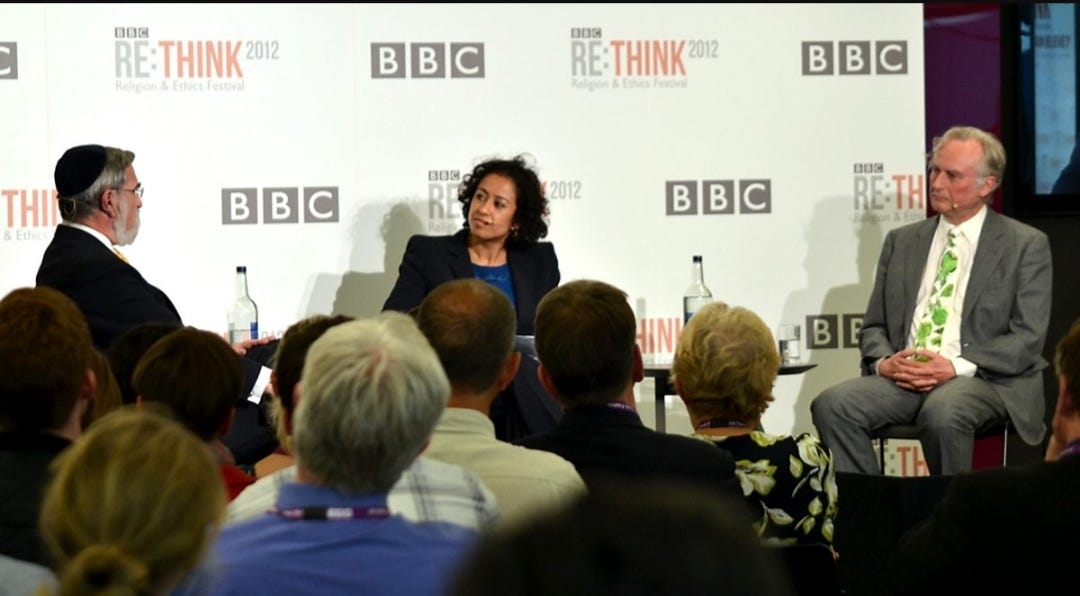
[Image: Rabbi Sacks debating New Athiest Richard Dawkins at the BBC. Science isn’t the enemy of religion, but a fulfilment of the monotheistic prophecy of linear time. Humans can tame nature.]
With the Enlightenment and the age of science these words of a hoped-for future became a lived reality. Science helped us to understand the world. Then technology gave us the tools to control it. With the growth of knowledge and the banishment of ignorance, humanity managed to break through the chains of its natural master. So long gaslighted that world around us was a mother, we strode free. We took the whip from the bloody hands of our environmental tyrant and subjected “her” to forces of enslavement that she had once meted out to us. So destructively and so unlovingly, she had treated us with contempt. Now nature would sing to our tune.
Science. Technology. The God of monotheism. They are one project. The protest against determinism. The belief in a future. The active response in the face of insurmountable odds.
There is no humanism and no religion. There is just the united belief that “yes we can”. We can do it. We can change the world. And where once a century could pass by with no development whatsoever - just misery and poverty and whatever despicable disease or famine the hand of fate dealt us - today a decade is a lifetime. Only a fool would predict what the world will look like in 40 years from now. Time is linear and moves with haste towards its new exciting destination.
True enough, there is still war in this world and the hand of unbearable suffering still hangs hatefully over the unfortunate. But our ability to tame the terrorism of nature grows stronger. Steven Pinker - not a man usually associated with an article citing Hosea and Elijah - has spoken in great depth of the huge strides we have made as a civilisation in matters as wide ranging as taming violence and expelling famine. The Roslings have done likewise in their bestseller Factfulness. And though we still have great challenges in many domains of our civilised life, particularly in the safeguarding of our democratic liberties, we are becoming ever more sophisticated at suppressing the latest terror attack nature throws in our direction.
Climate Change: Nature strikes back
In the above light, the climate change debate suffers from an complete lack of historical awareness. Children who have grow up in a world of ubiquitous technology pine for days where we lived passively with nature and submitted to its latest horrific act of destruction. The “educated” (Pinker excluded!) speak with romance about a non-existence golden age where we danced with trees and spoke sweet nothings with kindly waves. All seem unaware that our entire history is a testament of liberation from a faceless, remorseless adversary that did nothing but make our lives a complete misery. We are in a struggle. And we are winning. But sin - surrender to superstition and defeat to nature’s dominance - will bring the tragedy of history full circle.
We must continue to remember, to chant and to call from the rooftops: There is hope. There is a future. And we must never lose sight of a better world ahead, brought about by the power of humanity as agents of positive change.
It is true that nature is trying to get her revenge. Climate change is already affecting life on this planet in dramatic ways. But rather than viewing this as the destruction of nature, we should view it as nature trying to strike back. It is a call to human ingenuity. Made in the image and likeness of God, we have the power to innovate and to bring technological change to bare on this greatest of challenges.
There is a future
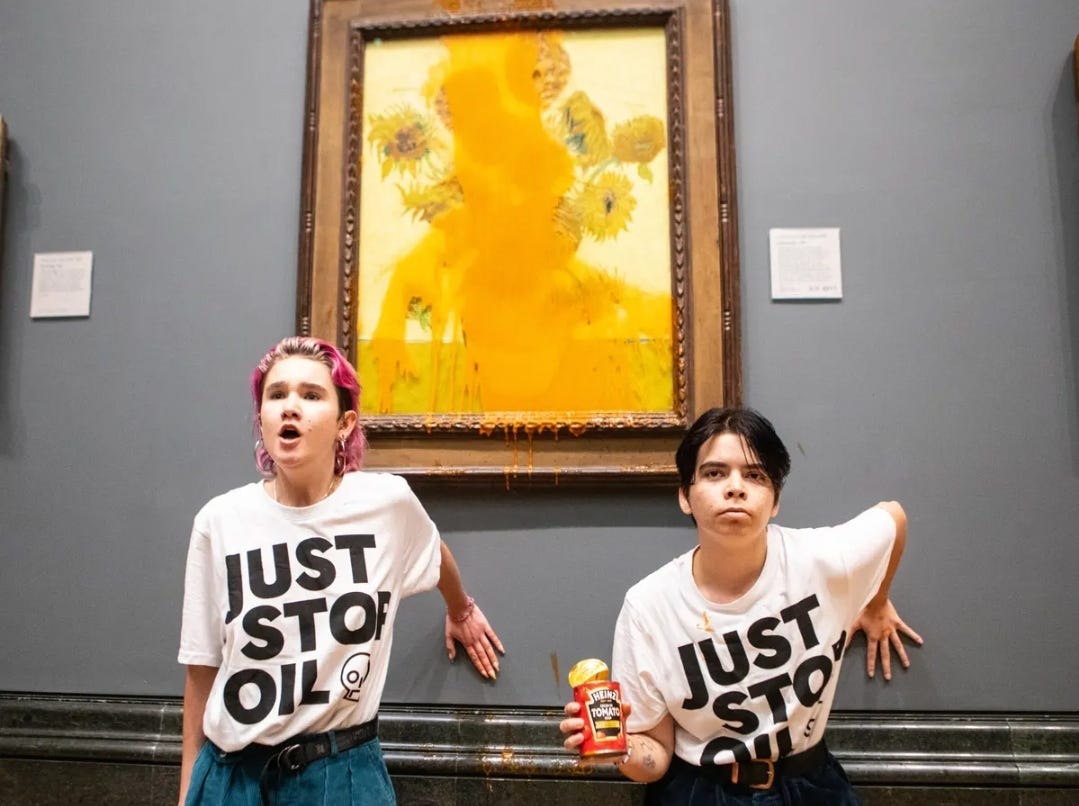
[Image: Just Stop Oil. Protesters hoping for a return to a golden age before civilisation. Retrieved from the Guardian website.]
The natural devil is telling us to return to slavery. To Egypt. To the hell of cyclical time. “Just stop oil” protesters would have us tear up human civilisation and progress in the name of returning to our hellish past. We must say NO. Naturally (no pun intended), we should co-exist with nature. We must reduce our plastic output, find alternatives to carbon and conserve the natural world as far as possible. And we can do better in this regard.
Yet this is not a tale of woe. It a call to innovate and bring nature even more tightly under our control through the marriage of monotheistic hope, science and technology. A still, small voice calls from Heaven. It tells us that if we believe, the human project will go on and on. It a Godly project. It is a project of freedom. And we must heed the call. Or else return to the tragedy of cyclical time.
I, of course, believe that we must make good environmental choices on a personal level. But most of all, I believe that science and technology can provide the solutions to our predicament. And this isn’t blind faith or scientific hubris. It is the very essence of monotheism.
There is a future.

Please consider supporting this publication with a paid subscription:
Ashok Panikkar on the negative side of progress:

An inspirational lecture on monotheism, nature and cyclical time by Micah Goodman:
*Reference to Yuval Noah Harari's Sapiens
👏👏👏 An all-time classic article by you just in time for Rosh Hashanah, Daniel! You remind us why science and technology whatever their faults, are great things. We human beings were once at the mercy of the environment. Now we have the ability to mitigate its effects, help feed ourselves all year round and even control the environment itself. That was all thanks to the brilliant minds in the scientific community like Sir Isaac Newton, Albert Einstein, Louis Pasteur, Marie Curie, Dr. Jonas Salk, Galileo Galilei, Charles Darwin, Rosalind Franklin, Niehls Bohr, Nikolai Tesla, Jane Goodall, Ada Lovelace, Johannes Kepler, Nicolaus Copernicus, Archimedes, George Washington Carver, Gregor Mendel, Carl Linnaeus, Rene Descartes, Alexander Graham Bell, Aristotle, and Thomas Edison. Much like how monotheistic religion has as an element of faith in it, so does science and technology. We must have faith they can help us achieve a brighter, happier and more prosperous future. Climate Change should not be viewed as the destruction of nature but rather as nature striking back. Science and technology CAN help us combat and weather the storm (no pun intended) of Climate Change! Those stuffy left-wing academics and activists who dream to return to the “simplicity and tranquility” of a “simpler time” where nature was king before civilization came about have no idea what they’re talking about! Shanah Tova, Daniel!
From Ashok:
Fascinating essay, Daniel. You make a great case for not regressing back to any kind of an idyllic and mythical past. Using somewhat different vocabulary, here's how I would (mostly) agree with you: Unlike other creatures on the planet, we humans are blessed with an extraordinary mind- one capable of complex analysis, description and- innovation. This has allowed us to develop (albeit glacially and over a couple of millennia) extraordinary tools, techniques and technologies that extended our limbs, senses, nervous systems and minds. This allowed us break out of the cyclical tyranny of nature and chart our own path- developing complex social and civilizational structures and systems. I agree with you that we are so much better off as a species for this.