


Tyrell speaks for a lot of readers in his generous, but critical, interpretation of Burnham’s speech. His points are “obvious,” but as with so much that is obvious, it needs to be said, it needs to be said repeatedly and it needs to be said well. In my own topics of interest, I also feel compelled to say the obvious against an elite intellectual society so determined to make ridiculous claims of genocide, apartheid and other such blood libels. Yet obviousness applies equally to issues in domestic politics. Thanks to Tyrell for bringing the obvious to life so vividly. (His Substack link can be found at the bottom of the article.) - Daniel Clarke-Serret (editor)
The Latest Chapter of The Genocide of Truth where I get to root of the doctrine of Progressive Palestinianism. Please read and support:

“Andy Burnham’s Speech - Utopia” by Tyrell Bowman
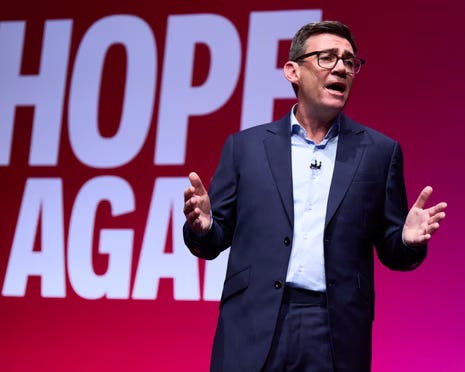
I do not dislike Andy Burnham. In fact, watching him at Labour conference, it was easy to understand why the hall repeatedly rose to its feet. He is passionate, energetic and capable of communicating an idea with something resembling genuine human emotion, which in modern British politics is becoming something of a collector’s item.
His speech was first-class political showmanship. He understood exactly what the Labour faithful wanted to hear and gave it to them in generous portions: kindness, security, public services, social justice, council housing, apprenticeships, mental-health support, cheaper transport, greater public control of utilities and, most significantly, a new National Care Service standing alongside the NHS.
It is an enormously attractive sales pitch because most of us want the same things. We want elderly people cared for properly. We want children with special educational needs to receive support. We want young people to have opportunities, families to have decent homes and people suffering mental-health problems to get help before their lives unravel.
Burnham’s vision is therefore difficult to attack on the grounds of intention, because the intentions are largely admirable. The problem is not what he wants to achieve. The problem is how on earth Britain pays for it.
At the heart of the speech was an old and very powerful socialist promise: the State will look after you. From childhood to old age, it will educate you, train you, house you, treat you, support you when you lose your job, protect you when things go wrong and care for you when you can no longer care for yourself.
There is something wonderfully reassuring about that. Frankly, some mornings I rather fancy handing Whitehall my electricity bill, mortgage, car keys and dog and telling them to give me a ring when everything has been sorted out.
But somewhere along the way Britain has developed an increasingly unhealthy relationship with government. Whenever something goes wrong, our first question is no longer necessarily, “What can I do about this?” It is increasingly, “What is the Government going to do about it?”
Lost your job? Government programme. Struggling with rent? Government support. Energy too expensive? Government subsidy. Child struggling at school? Government intervention. Need retraining, counselling, transport, housing or care? Increasingly, the answer is another state scheme, another department and another budget.
The welfare state was created as a safety net, and a civilised country absolutely needs one. But there is a difference between a safety net and a hammock, and there is an even greater difference between helping citizens when they fall and creating a nation of adult children permanently waiting for Mum and Dad Government to sort everything out.
That is the uncomfortable part of Burnham’s Utopia. The benevolent State gradually becomes the benevolent parent, while the citizen becomes the dependent child. Responsibility moves upwards until almost every difficulty in ordinary life eventually arrives at somebody’s desk in Whitehall.
The trouble is that government is not Mum and Dad. Mum and Dad normally have to earn the money before they spend it, whereas government has the additional convenience of taxing somebody else, borrowing the rest and leaving the invoice for people who have not yet been born.
Britain is now approaching £3 trillion of public debt. Government borrowing remains enormous, the cost of servicing that debt has risen substantially, taxation is already historically high and economic growth remains painfully modest. Against that backdrop Burnham is proposing another great expansion of the responsibilities of the State.
Social care undoubtedly needs reform. SEND provision desperately needs improvement. The NHS remains under extraordinary pressure despite vast amounts of additional money being poured into it. Councils are already watching adult social care and special educational needs consume an extraordinary proportion of their budgets, while residents simultaneously wonder why council tax keeps climbing and the pothole outside their house is developing its own postcode.
Burnham believes greater spending now can save money later. Better care could reduce pressure on hospitals, better youth services might prevent long-term unemployment, better mental-health support could return people to work and more council housing could reduce the enormous housing-benefit bill.
There is logic in all of this, and some of it may well work. But government has been promising that spending more today will save considerably more tomorrow for decades, and tomorrow has developed an unfortunate habit of never quite arriving.
This is where the entire proposition collides with the economy. You cannot redistribute wealth until somebody has created it, and Britain currently seems increasingly uncomfortable with the people and businesses who actually do that creating.
Entrepreneurs, investors and successful companies are not an infinitely renewable natural resource growing underneath the Treasury. They can move, invest elsewhere, employ people elsewhere and decide that Britain has become simply too expensive, too complicated or too hostile to bother with.
Burnham’s compassionate state therefore depends upon the very thing parts of the Left have historically regarded with suspicion: successful capitalism. The National Care Service needs profitable companies. The NHS needs profitable companies. Council housing, SEND provision, mental-health services and apprenticeships all ultimately require a productive economy generating wages, profits and taxation.
Without wealth creation there is nothing meaningful to redistribute. You cannot tax a nation into prosperity any more than you can improve your household finances by repeatedly transferring money from your current account to your savings account while your salary disappears.
This is also why the dismissal of the Thatcher era is too simplistic. Thatcher was far from perfect and some of the economic changes of the 1980s inflicted terrible damage on particular communities, but she emerged from an era when Britain had already endured inflation, industrial conflict, economic stagnation and an IMF bailout.
The central lesson of that period was not that government was evil. It was that government could not indefinitely promise more than the productive economy underneath it was capable of supporting.
That lesson is becoming relevant again.
I am not suggesting Britain in 2026 is simply 1976 with smartphones and Deliveroo. The economy, labour market and financial system are very different, but some of the ingredients should nevertheless make us uncomfortable: high public debt, enormous spending commitments, weak productivity, high taxation, expensive borrowing, creaking public services and growing frustration among the population.
Then add artificial intelligence, which could transform millions of jobs over the next decade, and the problem becomes even more complicated. Burnham is proposing a larger protective state just as the employment patterns and tax base required to finance it may themselves be undergoing profound disruption.
This is why I think Britain is approaching a fiscal precipice. That does not mean collapse tomorrow morning, but it does mean that without substantially stronger economic growth the numbers become progressively harder to reconcile.
Eventually something has to give. Taxes rise further, borrowing increases, services are rationed, promises are broken or financial markets decide that lending Britain money requires an increasingly painful price.
None of this makes Burnham a villain. In many respects it makes his speech more interesting, because he is articulating something millions of people genuinely want: a kinder country in which people feel protected from the worst consequences of illness, unemployment, old age and misfortune.
I want that too. Most reasonable people do.
But kindness has to be paid for, compassion requires resources and security cannot be created by political declaration. Before the State can distribute wealth, somebody somewhere has to get out of bed, build something, invent something, invest in something, sell something, employ somebody and make a profit.
That is the missing half of Burnham’s Utopia.
We have become accustomed to believing that government can solve almost every problem placed before it. It cannot, and pretending otherwise risks creating an increasingly infantilised society in which responsibility is endlessly transferred upwards until government itself eventually buckles beneath the weight.
A mature country needs a strong safety net, excellent public services and genuine compassion for those who cannot help themselves. It also needs independent adults, strong families, functioning communities, profitable businesses and citizens who understand that government cannot permanently protect everybody from every consequence of life.
Burnham’s vision is seductive because it promises security, reassurance and kindness. The road he described at Labour conference is lined with very good intentions indeed.
The question is whether the road actually leads to Utopia, or whether Britain reaches the end of it and discovers that somebody forgot to fill the petrol tank.

Thank you.
👏👏👏 An article that was a treat to read by Tyrell Bowman!