


FOREWORD BY THE EDITOR (Daniel Clarke-Serret):
Guerre and Shalom is currently in the top twenty Substacks for philosophy, so it quite the honour to welcome esteemed feminist philosopher (and prolific writer on her Substack BordoLines) Susan Bordo to write for the publication. In a future collaboration, Susan will write an exclusive article for us on her academic speciality of the human body, but for today, she will be sharing her thoughts on American politics and in particular, the misogyny lurking in certain corners of the Democrat Party. Susan argues for the centrality of “women’s issues” to mainstream American working-class people and questions whether some in the US are ready for a female President. It’s fair the to say that Bernie Sanders isn’t going to like this one….
Susan is Professor of Gender and Women's Studies and holds the Otis A. Singletary Chair in the Humanities at the University of Kentucky. Instead of failing to do her career justice, allow me to quote at length from her website:
Cultural historian Susan Bordo’s books and articles are responsible for many firsts. As a young feminist philosopher in a male-dominated discipline, she was the first to examine 17th century philosophy and culture from the perspective of gender. In Unbearable Weight, she broke with the medical establishment and prevailing psychological explanations to draw attention to the profound role of cultural images in the spread of eating problems across race and class. Her next book, The Male Body: A New Look at Men in Public and in Private, brought a woman’s perspective to the then-emerging field of masculinity studies, and was hailed by many men as one of the most sympathetic feminist accounts of their insecurities. Twilight Zones, a collection of essays based on her public talks in the 1980’s and 90’s, presciently diagnoses the cultural and political assault on fact and evidence that reached a zenith in the second decade of the 21th century. The Creation of Anne Boleyn: A New Look at England’s Most Notorious Queen was the first to challenge the stereotypes and ill-founded narratives that dominated literary and historical accounts of Boleyn’s life. Bordo’s most recent books, The Destruction of Hillary Clinton and its follow-up collection of essays Imagine Bernie Sanders as a Woman remain the only accounts of 2016 and its aftermath that examine all the elements of the perfect storm—including the role of the mainstream media—that led to the elevation and reign of Donald Trump and Trumpism.
We thank Susan again for agreeing to feature on Guerre and Shalom and strongly recommend that you subscribe to her Substack BordoLines.
Subscribe as paid today!
“Bernie Sanders’ Irrepressible Misogyny and Why It Matters” by Susan Bordo
I went to High School with a lot of guys like Bernie Sanders. In the late 60’s, when I lived in Hyde Park, I watched them with their bullhorns on the steps of the University of Chicago. I dated some of them. They roused a generation to campus activism and shoved politically engaged women—black and white, many of whom had been leaders in the civil rights movement in the South—out of the spotlight. When those women started their own movement and changed what “liberation” required, the guys with the bullhorns had a choice: listen and learn or don’t.
We’re all in our 70s and 80s now, and we know—as younger people may not—how much that moment defined us. Listen to women. Or don’t. Men (and women) are still faced with that choice, in some way or other, almost every day.
I could see from early on which kind of guy Bernie Sanders was.
It was clear when in 2016 he told a cheering crowd that Planned Parenthood and NARAL were “establishment” and dismissed abortion as “a social issue.” (Katha Pollitt had it exactly right when she said “Bernie is a traditional leftist for whom feminism is a distraction.”)
It was clear when he didn’t shut down his followers who called Hillary “the whore of Wall Street.” (He doesn’t believe in suppressing free speech, you see.)
It was clear when he (along with Trump) accused Hillary of “playing the woman card”: “No one has ever heard me say ‘Hey guys, let’s stand together, vote for a man.’ I would never do that, never have.” (Never had to either.)
It was clear when he told reporters that Clinton “has to be willing to get out of what’s comfortable and get on the streets,” obviously ignorant of the fact that at the age of twenty-four, Hillary had been a civil rights activist who went undercover to investigate discrimination in public schools.
It was clear when in an interview with George Stephanapolous, Sanders told his young followers that “I don’t wanna see the American people voting for the lesser of two evils. I want the American people to be voting for a vision of economic justice, of environmental justice, of racial justice.”
Stephanapolous: “Is that how you would describe Hillary Clinton against Donald Trump — as the lesser of two evils”?
Sanders: “Well if you look — No, I wouldn’t describe it, but that’s what the American people are saying.” (And also, Bernie, what you just said.)
It was clear when, after he’d reassured his supporters that “our revolution” will still go on despite Hillary’s nomination, he described her signal achievement as having been “a great First Lady.” (After that, I guess, she had a very long nap.)
It was clear from the tepid, grudging way he “supported” Hillary—who, let’s not forget, was running against TRUMP. Sure, Sanders never said to “lock her up.” But he made no attempt to correct “Bernie or Busters” when they said things like: “If we don’t get Bernie, we’re not just going to automatically vote for the demon.” Nor did he dispute Susan Sarandon when she described Hillary Clinton as “more dangerous” than Donald Trump. (And then he later told CNN reporter Annie Grayer that he “worked as hard as humanly possible” once Clinton was the Democratic nominee. GMAB.)
It’s clear from the way he talks about the “working class.” I put that in scare quotes because if you scratch at Bernie’s notion of “working class,” you usually find a white man with his sleeves rolled up, not a Honduran woman living in Texas, cleaning houses, wondering what she’s going to do now that she’s discovered she’s pregnant.
It was clear when, after saying repeatedly that he’d love to see “the right kind of woman” as POTUS (as opposed to HRC) he ran again in 2019 rather than throw his support behind fellow progressive Elizabeth Warren. And then he had the chutzpah to criticize her for staying in the race and “dividing the progressive vote” rather than dropping out.¹
It’s clear from the fact that he never emphasizes that reproductive justice and access are not just “social issues” (as he’d once claimed) or only about “choice” or “women’s rights”, but are economic issues that affect everyone, especially the poor and “working class.”
Let me pause a moment to spend some time on that point, because it was one that Kamala Harris made over and over but received virtually no support for from male champions of the “working class,” who continued to define “economic issues” in male-centric terms. (They still do, criticizing Kamala for having no economic plan.)
A quotation from Laura Tyson comprehensive piece, “Abortion and Reproductive Rights are Economic Issues,”:
In a recent television appearance, Michigan Governor Gretchen Whitmer highlighted an all-too-often unrecognized reality: reproductive rights are an economic issue – and not only for women. “The most important, profound decision a person will make, especially a woman, or family, is whether and when to bear a child,” she noted. “So, this is about our personal economy. This is about our collective economy. How can women get into the workforce if they cannot make their own decisions about whether or when to bear a child or access health care?”
Whitmer is absolutely right. Too often, the press and voters treat abortion, and reproductive rights more broadly, as well as other “family” issues – like child tax credits, paid family leave policies and affordable childcare – as somehow different from economic issues. But they are not. All of these issues have significant long-term economic consequences for women, for their families, and for the economy.
This was something that Stacey Abrams, in her 2022 run for governor, also had emphasized. “Abortion is an economic issue,” she insisted, for example in responding on Morning Joe to Mike Barnacle, who conceded that abortion is “an issue,” but “nowhere reaches” the importance as the price of food, gas, or housing. Abrams reminded him that caring for children is why we worry about food, gas, and housing. And since women are the ones who bear children, for women, “this is not a reductive issue. You can’t divorce being forced to carry an unwanted pregnancy from the economic realities of having a child.”
Unfortunately, the message didn’t get through.² After Abrams lost, male pundits attributed her loss to the fact that her “platform tended to highlight issues of concern to women voters.” They just didn’t get the fact that every limitation on a woman’s ability to bring income into the family also places a greater economic burden on husbands and partners. The burden may be mitigated if one can afford child care or has it provided at work, but it rarely is. So it’s no surprise, as Tyson outlines in blistering detail, that “there are strong links between poverty and abortion – denying access to abortion places the greatest economic burden and significant health risks on low-income, often minority women, increasing both poverty and inequality.”
All of this means reproductive “issues” are issues for men as well as women—and not just because of their emotional ties with women and girls, which have tended to be emphasized in men’s “pro-choice” movements, but because insofar as the economic well-being of families is not dependent on their earnings alone, what happens to their female wives and partners matters to their economic well-being too.
I wish more men saw it this way. If they did, we might not have had the lop-sided voting that, as statistics now show, played a huge role in the election of 2024. When Catalyst, a progressive organization that analyzes voter data, released its report entitled “What Happened in 2024,” it was starkly clear:
While women supported Kamala Harris at nearly the same levels that they supported Joe Biden in 2020, the share of men backing the Democratic ticket dropped from 48% in 2020 to 42% in 2024. In all, there was an 11-point shift from Democrats to Republicans. These declines were evident across every major demographic group.
For example, white and black women supported Biden and Harris at levels virtually unchanged from 2020, but there was a four-point drop among white men and a seven-point drop among Black men. Support for Democrats among Latino women fell by seven points, but among Latino men, the decline was 12 points.
Even more striking is the drop-off with younger voters. According to Catalist, “the gender gap among 18 to 29 year olds widened to 17 points as women dropped slightly from 66% Democratic support in 2020 to 63% in 2024 while men dropped much further from 55% Democratic support in 2020 to 46% in 2024.”statistical evidence demonstrating that voters’ gender played a huge role in the election.
Was Bernie Sanders responsible for this? Of course not. Trump had gone aggressively after the bros, capitalizing on their hostility toward feminists and “uppity” women like Kamala and their recoil at the idea of a woman president. But in claiming “the reputational space of strength and masculinity” Trump didn’t just bring Hulk Hogan bursting out of his shirt onto the stage. Particularly when directing themselves to young Black and Latino men, the Republicans had strongly played the “working-class” card, emphasizing the lost jobs they’d bring back, restoring men’s ability to provide for a family, etc. That could have been Bernie’s chance to get in there and back Kamala on reproductive choice and access as crucial to stabilizing and enhancing working-class men’s lives.
But nah.
Instead, he complained that Kamala was a bust among union workers.
Note that late in the interview, Bernie concedes the “enormous importance” of “a number of good ideas” that Kamala has put forth. But somehow, those don’t add up to “standing up for working families.”
Why not? According to the guru of “progressivism,” it’s because Kamala’s proposals don’t include a position on the minimum wage. “It’s hard to understand why Kamala has not come out on that issue” he says. (Why not give her a call, Bernie, and ask her?) Then, too, she hasn’t been “strong enough” on labor issues. Not like Biden, who Bernie considers the one “exception” to the Democrat’s weakness on working-class issues. When Alex points out that Biden (unlike Hillary, who did much better) also got only 50% of the union vote, Bernie disputes her numbers (“The polling I’ve seen suggests Kamala is not doing as well” he insists) and there’s a rising level of upset (louder voice, waging finger, etc.) in Sanders.
Does he have a special investment in Kamala being the “worst”?
Finally in the interview, after Bernie has conceded that Kamala has those “good ideas” for helping working families, the problem becomes that she hasn’t been “emotional” enough about it. “People are hurting and need to know someone is standing up and fighting for them.” People need to be able to say: “Hey, see that lady there, she’s on my side. If she does that, she’ll win a whole lot more working people.”
I guess she didn’t bellow or wag her finger enough.
Or maybe her proposals were illustrated with examples that were too….female? Unlike Trump, Kamala proposed an “opportunity economy” that had actual plans—not just “concepts” of plans—for making the cost of housing, child-care, senior-care, education less back-breaking. But she didn’t talk vaguely or metaphorically about “kitchen table issues”; she recalled the actual kitchen table at which her actual working-class mother sat, figuring out how to pay the bills. She vividly described the everyday challenges of caring for aging parents—and proposed actual dollars that would help buy the soothing lotion for papery skin. And she insisted that reproductive choice and access was itself an “economic issue.”
Let’s see what UAW President Shawn Fain had to say about Kamala and the “working class”.
I don’t use the term “misogyny” casually. In fact, I rarely use it. And when I do use it, I try to specify precisely what kind of misogyny I’m talking about.
Most misogynists don’t have issues with all women. The women they see as extensions of themselves, perhaps a daughter, perhaps an acolyte, don’t rouse the same nervous hostility in them that women who situate themselves as equals—especially if they are competitors—do. For Bernie, AOC falls into the “(surrogate) daughter/extension of self” category. Hillary, Elizabeth Warren and Kamala Harris definitely do not. They are not just older than AOC, but nothing about them is apprentice-like. AOC may be on the road to being like that, but as long as she behaves like Bernie’s heir, he’ll be okay with it.
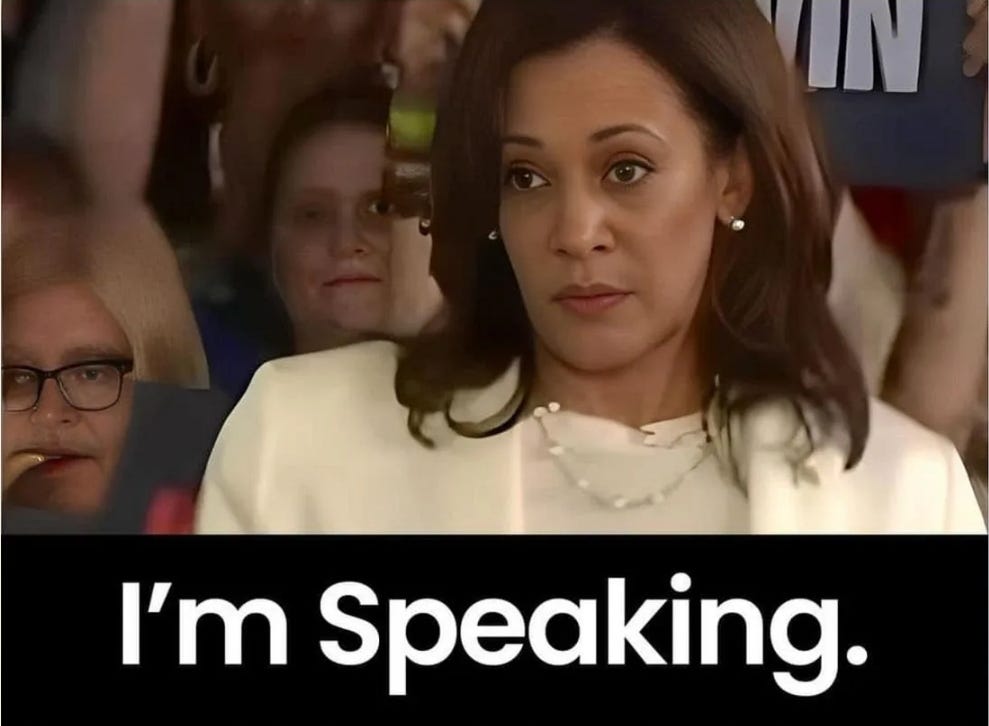
I’ve often been asked/told: “Why can’t you let it go?” They’re referring to my two books and several articles in which I take Bernie to task.
It’s true that I hold him responsible (although not only him) for the disaster of 2016, which was the beginning of the Trump regime.³
Hillary the “lesser of two evils”? I wonder if Bernie ever regrets having taught a generation of young progressives to see her that way?
I wonder if his tolerance of his followers’ crude and vile hatred of Hillary and her supporters⁴ wasn’t an inflection point in the blossoming of misogynist bro-culture that Trump was able to mine so well?
It’s also clear that there’s something Bernie can’t let go of either. Perhaps it’s partly due to his fierce desire to remain relevant—something he manages to pull off astoundingly well, judging from the crowds yelling his name at his “Against Oligarchy” Tour. But on that Tour and in many interviews since, he can’t seem to resist earning his cheers at the expense of the Democratic Party (of which he’s not a member, don’t forget) and recently, Kamala Harris in particular.
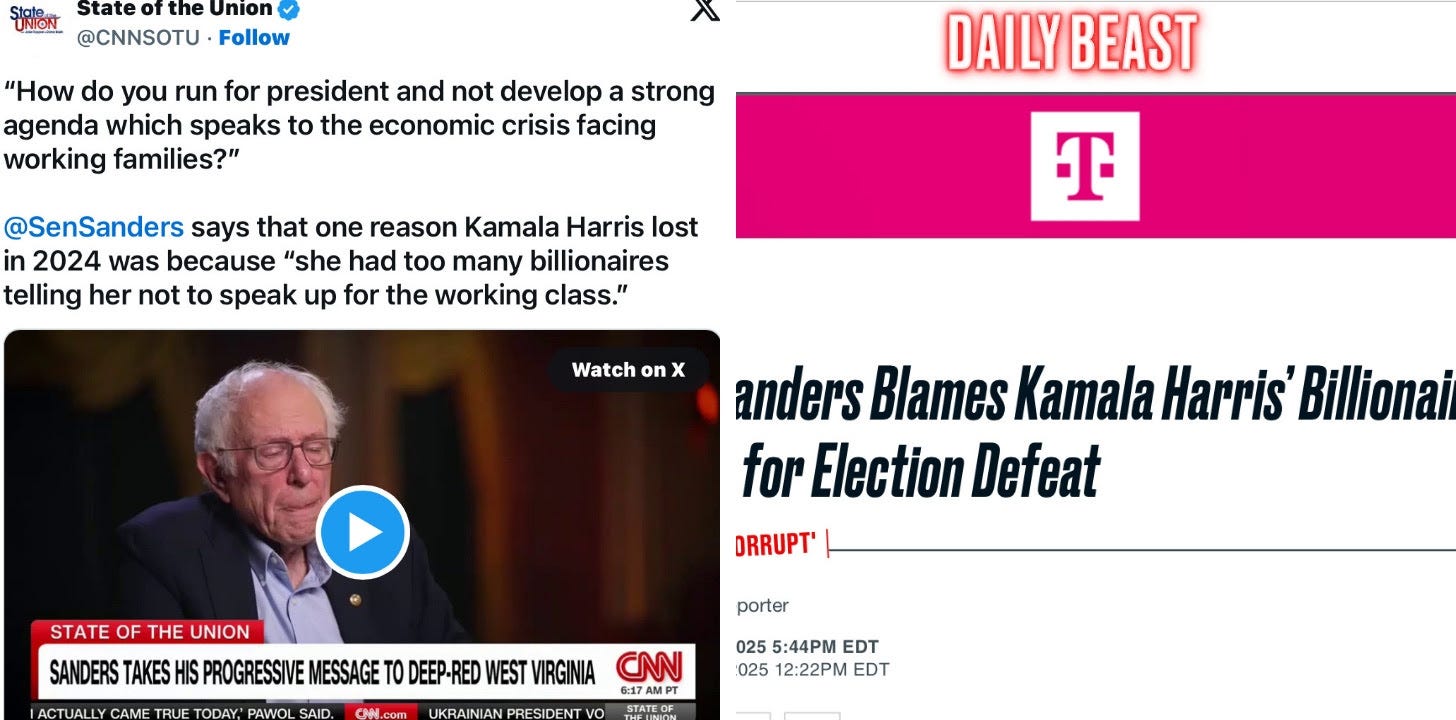
“I like Kamala, she’s a friend of mine,” he told host Dana Bash in an interview. (He’d said the same thing about Elizabeth Warren before launching into an attack on her. It’s a preface that reminds me of “Some of my best friends are Black” and it doesn’t melt my heart, Bernie.) “But her core consultants, you know, were very influenced by wealthy people.”
Kill me now, are we going to do that again?? He’d done it at every rally, the rant about how about “neither party” is “capable” of generating a grass-roots movement (apparently not true, if you’ve been watching Rachel Maddow’s weekly reports on the home-grown resistance to Trump) because both parties are “controlled by billionaires”:
“You got a Democratic Party, in general, that is dominated by billionaires, just as the Republican Party is. That operates under the leadership of a bunch of inside the Beltway consultants very well paid who are way out of touch with the 32,000 people here today.”
“Just as the Republican Party is” Is there a more perfect example of a false equivalence? Is this guy going to turn young Democrats away from the polls the way he did in 2016? Does he care, as long as his “message” is the dominant one? It seems not—at one point he actually suggested progressives join the Independent Party.
And then—interesting, it was just after Kamala announced she wouldn’t run for governor of California—he personalized his spiel, and aimed it directly at Kamala Harris. In West Virginia on Aug. 8, in a stop on the “Stop Oligarcy Tour”, Sanders told the crowd that one of the reasons Harris lost the election was that she had “too many billionaires telling her not to speak up for the working class of this country.” When he later lit into Elon Musk—“Billionaires should not be able to buy elections”—he didn’t distinguish between the “corrupt” nature of that transaction and his general comments about the “power of the oligarchs” in the Democratic Party.
The fact that Kamala had to rely on big-money donors is true. It would have been impossible to compete against Trump at all without them. That’s the fault of the Supreme Court and “Citizens United,” exacerbated by the truncated time-frame of her campaign. But billionaire donations to the Republicans far exceeded those to Democrats—whose donors included prominent left-wing women and Steven Spielberg, who it’s kinda hard to imagine telling Kamala “not to speak up for the working class of this country.” Just because people are loaded doesn’t mean their vision for the country is to renovate their yachts and screw the working-class.
But whatever she was “told” to do, from where does Bernie get the idea that Kamala Harris took marching orders from big money? Her economic proposals doesn’t bear that charge out, and when Dana Bash said something to that effect, suddenly Bernie didn’t want to “rehash” the campaign.
Again I ask: Does he have a special investment in finding fault with Kamala? Will there ever be a woman candidate who he enthusiastically endorses for POTUS?
His track record isn’t very good. And it speaks, not only of a “woman problem” but with the more general danger he poses to divide the Democratic Party into those who adopt his version of “progressivism” and his ideas about what constitutes “the working class”—which are not much changed from the glory days when young males dominated the left.
To close—some of my thoughts about why Kamala lost the election (by the slimmest margin, I remind Bernie, since Nixon-Humphrey: 1.49%)⁵
It didn’t matter that Kamala had economic proposals and Trump just had “concepts.” It didn’t matter that she travelled to the swing states, over and over, working tirelessly. (That old 2016 blame —that Hillary failed to go there at the end—was finally proven at most a tiny bit of the story.) It didn’t matter that she did address the problems of the working class. Or that she came from the working-class herself.
What mattered was that she didn’t talk or look “working-class” to white people (Black people knew better) but like a successful, professional, career-oriented woman. (The little Black girl who was bussed to a different district? She was forgotten, an old image from the distant history of the 2019 primaries.) What mattered was that she was married to a Jewish lawyer instead of an upstanding white Christian. What mattered was that she had the nerve to have all those degrees—and no biological children! What mattered was a self-assurance (“I’m speaking now”) that delighted Black women and Black and white feminists but was read as “uppity” by white suburban moms (not just a Black woman’s problem, Hillary had it too.) What mattered was the men who felt “unmanned” by all the women who they believed had taken the jobs that were rightfully theirs.
What mattered was a corporate “liberal” media who harassed her—as they had Hillary—for ignoring their demands for “hardball” interviews, who criticized her for preferring “softball” conversations, who seemed to be determined, once they got her to “sit down” with them, to expose “flip-flops” and treated her discomfort in answering “yes or no” questions as “word salad.” What mattered were the headlines and chyrons and leading questions that were the only sources of “news” for many people. Did she have what it takes to be POTUS? Would she fall apart without a teleprompter? Are “vibes” and “joy” all she has to offer? Is there any “substance” to her? After the “sugar high” was over, what exactly “defined” her and distinguished her from Biden?
What mattered was that Kamala—actually any Democrat running for office—had to wade through a mountain of right-wing disinformation about “cultural” issues. Like babies being killed at birth. Like pet-eating immigrants. Like kids being given sex-change operations during recess.
And they then had the nerve to say Trump won because of “the economy”?
Donald Trump had nothing to say to the “working class” other than magic words like “tariffs” and “groceries” and assurances that he alone could “fix it” by making sure immigrants don’t steal your jobs and rape your women and eat your pets. He won because of the mythology that he created and even the most decent of the Republicans swallowed or were silent about or were afraid to challenge. He won because he managed to convince those that were hurting that he would be their redemption, their retribution, their savior. When he was “reborn”—his ear barely grazed by something, maybe a bullet, maybe a tiny shard of glass—it fit right into that mythology. And so, too, did the persecution narrative, aided by the dedicated corrupt brilliance of the right-wing media. The deification of Trump made it easy to believe that, as with Jesus, all the charges against him were a witch-hunt, a “weaponization” of justice.
People voted for Trump not for his “economic policies” but because they mistook a reality-show creation for actual success at business. Because he was so “manly,” even when posing for a mug shot. Because he didn’t let the liberal press call the shots when he was on trial, but had the balls to insist on his own unhinged rants outside the courtroom in which he charged, over and over, that every prosecutor, judge, and jury who were “against him” had been hand-picked by “Biden’s DOJ.” And then took no questions from the press. (And for some strange reason, the press wasn’t as furious with him as they were with Kamala Harris when she “avoided” meeting with them in the two weeks after the DNC, as she travelled across the country.)
Young men voted for Donald because they liked all the faults that Dems mistakenly thought they’d recoil from: saying whatever disgusting thing he wanted to, doing whatever he felt like, grabbing any pussies in his vicinity. They liked that he said “fuck you” to the feminists. They didn’t want an accomplished, educated, articulate woman that made them feel “less than,” and they especially didn’t want a mixed-race woman with stature and confidence and a big laugh. They wanted a mirror of and permission to be themselves, just as they are. Donald gave them that.
Trump won not because of the price of eggs or Kamala’s inadequacies as a candidate but because too many men (and some, but far fewer women) still can’t deal with the idea of a woman president.
Don’t forget to sign up to BordoLines here.
This week is the 2 year anniversary of Guerre and Shalom. So for 3 days only, paid annual subscriptions will be priced at £35/$47.
FOOTNOTES:
1
Actually, it was Bernie who did that—in 2016–and probably will again in 2028, not by running himself but because who he backs still counts among “progressives.
2
The construction of polls was a big problem, too.
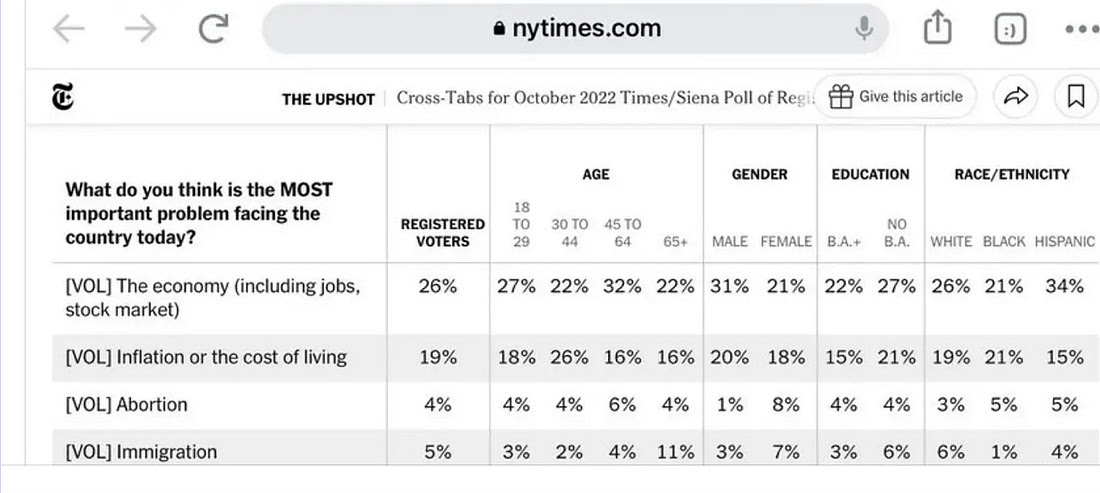
Notice how in this poll. “The economy” is specified as including “jobs” and the “stock market” and that’s it. But why is “the economy”—but none of the others—given specificity at all? And why “the stock market”—rather than, say, “health care”? Access to health care surely affects most people’s economic lives as much, if not more, than the stock market. Moreoever, specifying the "stock market" within "economy" is arguably biased toward the priorities of wealthy responders.
Note also that “the economy” and “abortion” are listed as though they are parallel types of items. They’re not. Listing them as such is what philosophers call a “category mistake.” “The Economy” is an umbrella term which can be interpreted to include virtually any aspect of life that has economic consequences. “Abortion” is one aspect of reproductive health (alongside contraception access, pregnancy care, IVF, medical assistance during miscarriages, etc.) and abstracting it in this way encourages people to think of it (unlike the all-embracing “economy’s”) as a “single issue” problem. This construct is biased toward choice of "the economy" as "most important,” even among respondents who care very much about reproductive freedom.
I’ve always found “the economy” a problem term. So vague, yet so loaded—as so many aspects of people’s lives can fall within that rubric, and commentators in the media tend to glom them all together under that one category.
Inflation/recession trends. Growth of jobs. Price of eggs, Deficit. Whether you can afford to buy a house? How much poverty there is? Whether families can afford childcare? Whether they can afford the meds they need? Just a feeling that it’s something a “businessman” is best able to handle? Something you remember was once “better” but can’t really say in what way?
Seems like there’s a whole bunch of different points of reference floating around out there. Yet the polls and pundits and the people they query keep insisting “the economy” is “the most important thing” without any precision as to what they’re talking about. And since the Republicans managed to convince so many people that they were the most trusted keepers of “the economy” (which hasn’t exactly been born out) it of course gave the GOP a special edge—even when, as has been the case over the last 4 years, the Democrats have actually done a far better job in any and all of the “sub”-categories.
Why is the poll construction important? Polls don’t just ask for your responses; through the way the questions are phrased and constructed, they also give you instruction in how to think about the issues, as in reinforcing the idea that “the economy” (defined, once again, as jobs and the stock market) is more important than issues that it presents as “single-issue” and thus less important. Like “abortion.”
3
My analysis of the election is multi-dimensional. See especially my 2017 book.
There are also several related articles in the BordoLines archive.
4
It was constant and it was vile. Let me give you a taste of what was thrown at me in the comments after a podcast interview with a self-identified male “progressive”:
What fucking planet is this bitch living on?
All you feminazi cunts are the bane of the Democratic Party and if you all left our collective IQ would go up at least 20 points. Take a bath with a toaster.
I can't wait till these Hillary cult members die.
Tell this woman to do some research before she hates on a guy just cuz he doesn't have a vagina!
Susan Bordo? the dumbass that claims everything except HRC is to blame? Fuck her.
This woman lies through her fucking teeth.
TOTAL LYING CRIMINAL CUNT
That woman is a fucking idiot
5 seconds in and it's clear she's as mad as a loon.
Feminist scholar? Such things exist?
I'm sure the fact that she is a lying, cheating, stealing, election rigging, pedophile enabling, child sex trafficking, wmd arms dealing, mass murdering war criminal, had nothing to do with it! Whether delusional or pathological liar, like her idol, this lunatic is beyond ludicrous! .
Delusional woman. Moron. Insane. Fuck you. Makes me want to vomit.
Le sigh....we're never going to get anywhere until these Baby Boomer shitbags are dead and buried.
Feminist and Jewish EWWWWWW NASTY BITCH
This bitch is retarded
That ugly old bitch is so biased for pussy
Yuck, another old white woman apologist for HRC.
5
I covered the 2024 election every week here on BordoLines. To easily access the articles, pull down “Election Watch 2024” among the categories at the top of the home page.

Great explanation of the dichotomy between how men and women think. Some exceptions though
The Democrats have no concept of what is working class, and project upon the poor their own ideals. This is especially true with progressives caught up in Marxist think.
Kamala was not working class. Both of her parents were professors at major universities; the closest contact she would have was with a custodian. (The $19/hour people whom the Columbia University progressives attacked in the administration building.)
Great articles, again. Thank you all so very much.
Respectfully
John Kornman