




Dear Zack Polanski and The Green Party of England and Wales,
Zionism is not a modern phenomenon. It’s a deep continuation, not only of the two temple periods, but also of the long and wrongly-forgotten exile. It is the essence of being Jewish. It is the right of a tiny people for self-determination.
Here is the thesis of serialising author Eli Kavon: We should stop considering exile as the Dark Ages for it was practise for Statehood. Diaspora life, along with the entire Jewish historical experience, forms one exciting, continuous story of Jewish memory that culminates in the return to The Land of Israel.
And throughout this narrative, we have a difficult balancing act and one that continues to this day: the righteousness of Jacob v the street smarts of Esau. Mr Polanski succeeds in having neither virtue.
Yours sincerely,
- Daniel Clarke-Serret (Editor of Guerre and Shalom)
Also from The Guerre and Shalom Publishing House:



Please subscribe as paid to access the chapters:
Jacob’s Voice, Esau’s Hands: A Zionist Polemic
by Eli Kavon
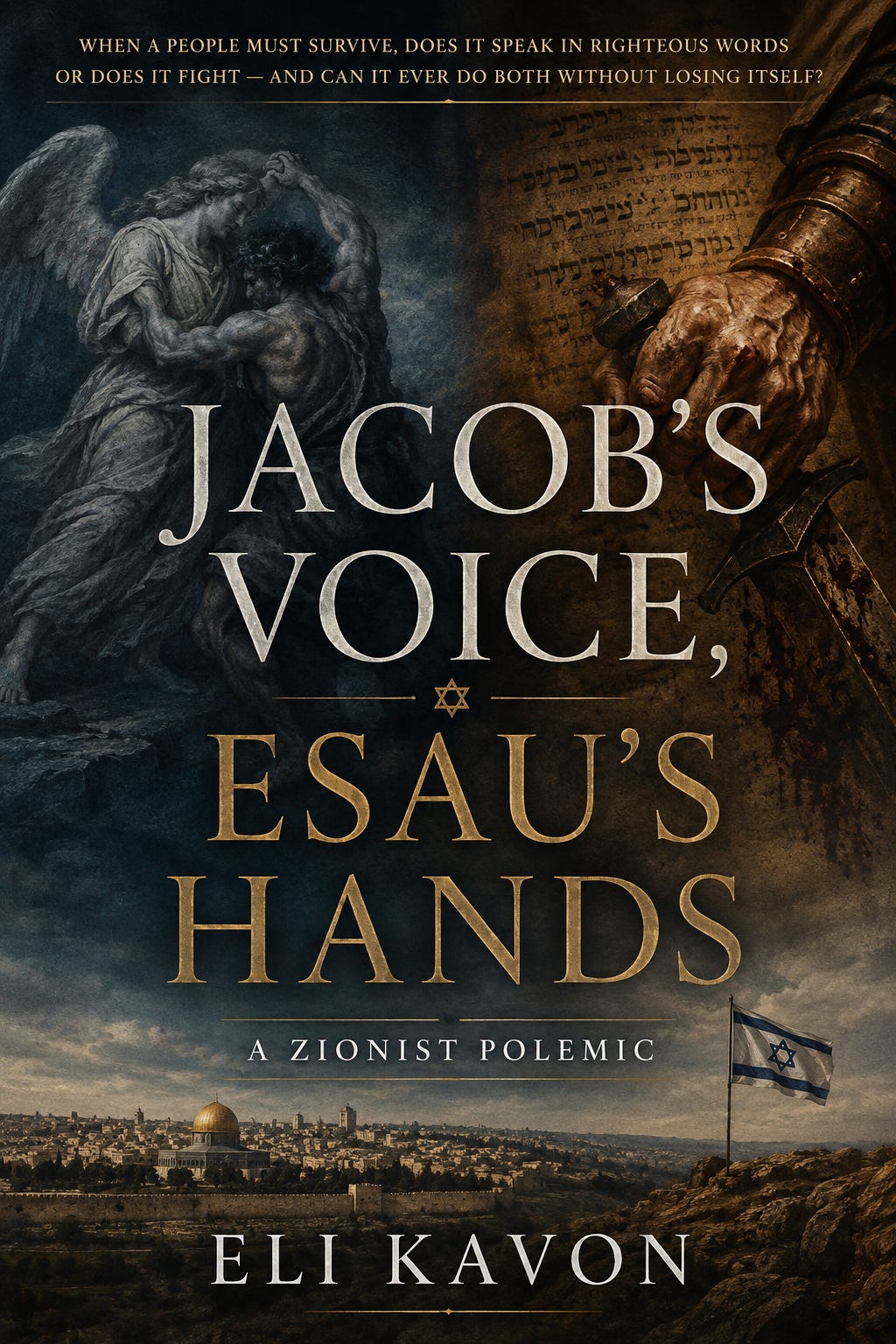
Introduction: The Birth of a Nation
PART 1] Foundations: The Claim of Continuity
Chapter 1: Jacob’s Journey: Evolution of a Patriarch. // Chapter 2: Triumph of the Jewish Polemic // Chapter 3: Reflections on Yerushalmi’s Zakhor
PART 2] Ancient Israel and Judah: The Ethics of Power
If there is continuity between Jewish memory and Jewish history, then that continuity must hold up under the pressure of the record itself. The chapters that follow turn from the patriarchs and the modern Zionist thinkers who claimed their inheritance to the ancient Israelites and Jews who actually lived it: kings, governors, and rabbis who had to decide, in real time and often at the cost of their lives, when to speak with the voice of Jacob and when to act with the hands of Esau.
Chapter 4: The Northern Kingdom Revisited: Beyond Sectarianism
The origins of the Kingdom of Israel in the north—the Northern Kingdom—remain a mystery. There is no reason to dismiss the biblical account of the northern tribes of a unified Davidic state breaking away from Jerusalem in a rebellion supported, initially, by the prophet Ahijah of Shiloh. But the picture of the Northern Kingdom seems more complex than simple rebellion and, later, deviation from the Covenant by building cultic centers outside of Jerusalem.
The Hebrew Bible’s depiction of the northerners as a state of renegade idol worshippers lacks nuance and complexity. We cannot be certain what type of sacrifice was carried on in Bethel and Dan. We can condemn the Kingdom of Israel founded by Jeroboam I as deviants from the Covenant and forgers of syncretistic Baal worship. At the same time, we can look beyond this value judgment and try to recover the history of northerners who took their religious life and their devotion to the God of Israel seriously. We must search beyond the “prison of the text.”
What was the nature of the rift between the prophets of the God of Israel—specifically Elijah—and the rulers in Samaria? According to historian H. Tadmor:
The close economic and military ties between Israel and the Syro-Phoenician states, in particular Tyre, led to increased cultural and religious influences from these areas upon Israel...A Temple to Baal in which Tyrian priests officiated, was erected in Samaria. Presumably, extensive sections of the higher classes such as state officials and courtiers, followed the royal lead.
The sudden prosperity of merchants and court circles in the newly erected capital must have brought into sharp focus the growing polarization between them and the conservative rural population. Although Biblical sources provide no details, the story of Naboth of Jezreel is an illustration of the internal struggle that placed the prophet in the role of opponent to the court.
What Tadmor describes adheres to the Hebrew Bible’s account of Baal worship in Samaria. But what of the temples in Bethel and Dan?
American archaeologist, Edward F. Campbell Jr., writing in The Oxford History of the Biblical World, attempts to explain the origin of the cultic centers in the North in the early years following secession from Jerusalem. His description departs from the prophetic condemnations of these centers of sacrifice representing solely idol worship:
From a more neutral point of view, Jeroboam probably intended to employ earlier iconography of Yahweh drawn from that of El. El as designation for the god of Israel was doubtless current in the north—hence the validity of using the name Isra-El for the northern political entity.
Jeroboam’s move, then, was not idolatrous or even newly syncretistic, but probably invoked ancient Israelite traditions, including a legitimate enlistment of priests from among the people. Frank Cross has proposed that Bethel and Dan served as a compromise agenda. Jeroboam, he surmises, reestablished the Bethel sanctuary as the locus of Aaronite priestly family hegemony, and Dan (Judges 18:30) for priests of the Moses line—the two families whom David had placed in Jerusalem (II Samuel 8:15). In short, Jeroboam’s moves were calculated, but (from a non-Jerusalem perspective) legitimate. Only from the perspective of [the Hebrew Bible’s authors] were they idolatrous.
Campbell goes beyond the caricature of the northerners as flagrant idol worshippers and provides a more nuanced description of temples in Bethel and Dan that took worship of God seriously. J. Alberto Soggin, Italian scholar of the Hebrew Bible, argues that at the cultic centers at Bethel and Dan “we do not have a syncretistic or idolatrous cult, but that the worship was offered to the self same YHWH.” The images of the bulls that were erected outside the temples might have been peculiar to the Canaanite Baal as a fertility god. But, Soggin argues, “it is in fact more reasonable to suppose that just as the ark in the Jerusalem temple was the throne of the invisible YHWH, so the bull at Bethel and Dan was the pedestal for the equally invisible YHWH.”
To simply dismiss the religion of the Northern Kingdom as sectarian and heretical is to render a theological value judgment rather than an historical analysis. While Jewish tradition remembers Bethel and Dan as the epitome of evil in the eyes of God—a judgment which has its place—it is the task of the historian to take us back thousands of years and attempt to render a picture as it was at the time.
The Northerners were not simply Baal worshippers. The sacrifices at Bethel and Dan involved a priesthood and a serious mode of worship. This is not all to dismiss Elijah, Elisha, Amos and Hosea, all prophets who had legitimate warnings about the behavior and actions of the Kingdom of Israel, its priests and its rulers. Yet historians and archaeologists liberate us from the confines of a text that has no interest in reproducing history as it was. Rather, it is a theological history in which the North always deviates from the Covenantal paradigm and is in a state of perpetual sin. But sectarianism and heresy is in the eyes of the beholder, usually the victor in history. And the victors of the South wrote the theological history of the Northern Kingdom.
Israeli Politics and the Idealization of the Northern Kingdom
While it is refreshing to bring new perspectives on the Northern Kingdom that liberate us from the confines of the biblical text, a disturbing trend in scholarship has gone too far in its positive representation of Jeroboam, Ahab and the Kingdom of Israel. This trend, represented by Israel Finkelstein, professor of archeology at Tel Aviv University, presents the Northern Kingdom as a sort of multicultural and pluralistic paradise that stands in contrast with an impoverished Kingdom of Judah that invented the stories of the evil North long after the Assyrian Exile of 721 BCE.
In The Bible Unearthed (2001) and David and Solomon (2006), Finkelstein and American archaeologist co-author Neil Asher Silberman have an agenda in degrading Jerusalem at the expense of Samaria. This follows logically from Finkelstein’s belief, based on his archeological digs, that the Hebrew Bible’s accounts of Kings David and Solomon were written in stages and over many centuries, representing a glorified version of these leaders that reflected the politics of the court of later kings of Judah, especially Josiah. For Finklestein and Silberman, David was not the king of a great empire but a local hilltop chieftain whose “kingdom” could not have sustained a large population or scribal literacy three thousand years ago. Therefore, Finkelstein and Silberman look to the Northern Kingdom as the dominant force and partner in Israelite society in contrast to a struggling Judah.
