


I’m feeling a little teary-eyed. This is the final chapter of PAX ARABICA.
PAX ARABICA is my groundbreaking new work exposing the Arab World for the colonial entity it is. Over the 20 chapters, we have looked into the nature of this Empire, its Palestinian vanguard, its dictatorial fragility, the oppression and expulsion of its minorities, its denial of national self-determination and how Arabs have mistakenly turned to Islamism as an escape from imperial oppression. We have turned our regard to those brave few who have fought the imperial menace and in Chapter 19, we considered how Israeli-Palestinian peace could come about in a post-imperial age.
Today, in the final chapter, we end the Great Game once and for all. We bring the curtain down on this accursed empire — an entity based on humiliation, terror, lies, language inversion, man-children, adventurism and an idolatrous sense of Hegelian History. We turn states into nations, boys into men, History into history, discretionary bureaucracy into law and the collective WE into individual, thoughtful “I”s. The time to decolonise the Arab Empire is now.
[Note that all capital letters in this chapter are used intentionally, especially History and We.]
PART 1: BABEL
Introduction: The time to change the narrative is now! // Chapter 1: On Arab Imperialism // Chapter 2: On the Vanguard //Chapter 3: On Dictatorial Oppression // Chapter 4: On Islamist “Freedom” // Chapter 5: On Islamist Misery // Chapter 6: On Arab Apartheid // Chapter 7: On Middle Eastern Minorities // Chapter 8: On the Masters of Ethnic Cleansing // Chapter 9: On Genocide, Slavery and Racist Indifference //Chapter 10: On Unjust “Justice” and the Inversion of Language // Chapter 11: On Appeasement // Chapter 12: On the Man who stood against Pax Arabica
PART 2: EDEN
Chapter 13: On Nations, States and the Nation State // Chapter 14: On Sykes-Picot // Chapter 15: On Zionism and the duty to protect // Chapter 16: On the New Regional Sheriff // Chapter 17: On the Psychology of Strength // Chapter 18: On the Paradigm Shift // Chapter 19: On the Post-Imperial Two State Solution // Chapter 20: On the End of the Great Game
PAX ARABICA
CHAPTER 20: On the End of the Great Game
AN EPILOGUE TO EMPIRE
“If you can fill the unforgiving minute
With sixty seconds’ worth of distance run,
Yours is the Earth and everything that’s in it,
And—which is more—you’ll be a Man, my son!”
(Rudyard Kipling1)
We the British
The Great Game is afoot2. The adventure has been set inexorably in motion. No more must we sit in misery in a land bound by law. No more must we sulk in desperation in a nation torn apart by class. There, beyond the sea, we will be free — to dig for gold, to acquire wealth in the Sun, to settle in a barely-peopled land. Our family will not command us. Our status will be ours to choose. The stuffy conservatism of home will be no more.
We arrived in Arabia with a hope in our heart — to find meaning in a world of capital, to find adventure where Darwinism starved us of agency. Science may say that we are descended from apes. Hah! It is mistaken. For though individuals are bound by that burden, we are not individuals. We are functions. We are cogs in the machine of History’s great purpose. What it aims at, who are we to say? But to be caught in its slipstream, is to be catapulted into the excitement of meaning; the exhilaration of purpose.
Upon leaving the shores of that grey island, where we were chained by a common law, a free press and an interfering Parliament; where we suffered under centuries of accumulated nationhood; we finally found peace. Anxiety was left at the border; impotence abandoned to suffocate in those smog-filled, hopeless streets.
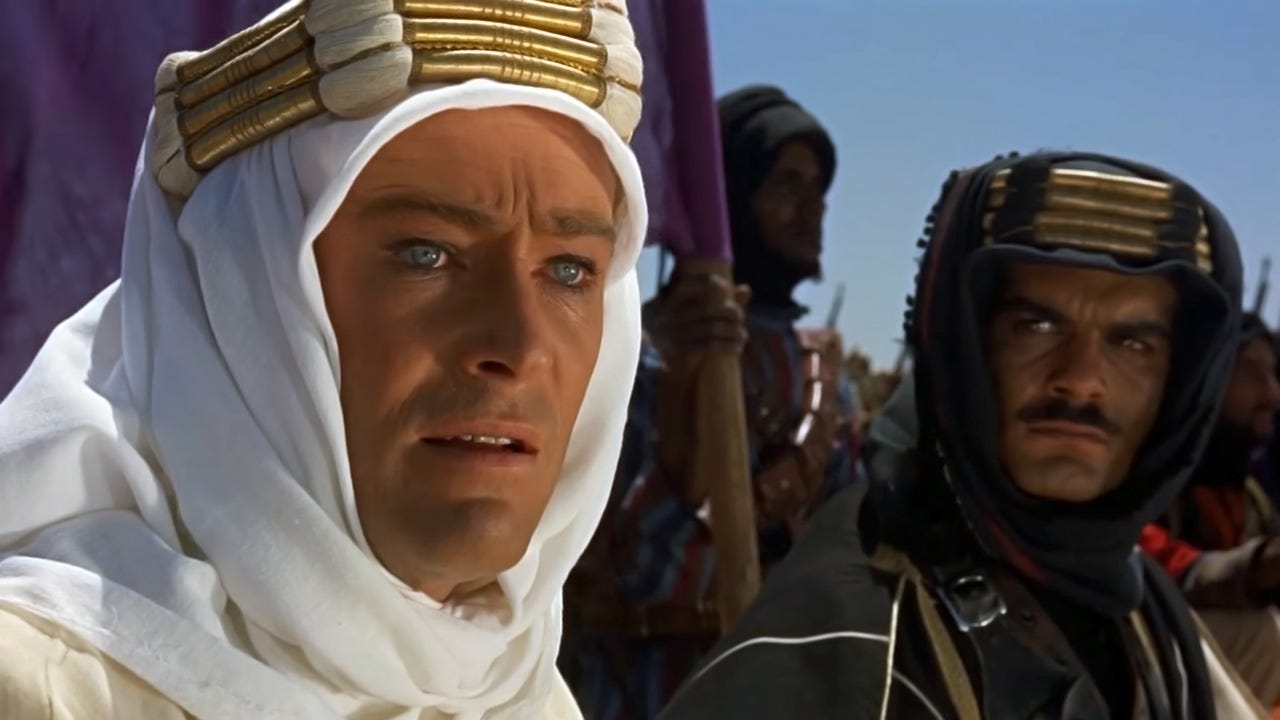
We were just 28 when we arrived there —charging through those desert sands with a great purpose. We were a boy, but our mission was christened by History. The same History that pushed St George to slay the Dragon; that impels his descendants to do likewise in foreign lands. I was not I. I was We. We all are — all those that sacrificed themselves to the will of the Game.
Our mission was to win the Arabs for the British — to join them together against their Turkish masters. Yet I was not British, nor was I Arab. I was a pawn in a game I didn’t understand. I was a pawn that could live out my boyhood. A Pan would had no need of age. I became We in a whirlwind of excitement; Hagel’s history made manifest.
The nation we fought for was not Britain — that was a land of democracy, mass franchise, law and human rights. We left that place to serve in its name, but to ignore its precepts. There, beyond the sea, we could live in a world of our imagination - Lord Cromer’s World - a world of secret bureaucracy where each official was a tool of discretion; a law unto himself.
There, in Britain, where debates are open and discussion is free, man is stifled by rules, precedent and principles. Here, in Cromer’s Egypt, in Rhodes’ Africa and Lawrence’s Arabia, there are no laws —only a nation that exists in our head. We, both the quixotic idealists and the raging mob, can finally live out our vision of “patriotism”, where written law is dead and all that remains is the arbitrary will of the bureaucracy — an officialdom unbound by the real Britain.
To be a civil servant at home is virtue lost; serving the property-owning classes without honour; mediating between factions that are loyal only to their own.
The aristocracy is a meritless caste, the workers are selfish and the bourgeoisie are vulgar. We were meant to represent the State, not the People; the united country above the mob. But there is no country! Only class unrest and endless striving.
So we fled — to Comer’s Egypt, to Rhodes Africa. There we were, the patriots of La Mancha, fighting our chains of boredom with an imagined “Britain”. Some of us fled with ideals - the followers of Kipling’s legend3. Others went as hodlums to make crime law. Others still went to expand for expansion’s sake; to annex the planets if we could4. Only then could we unite a nation with purpose - expansion! - to make meaning matter once more.
But how we were stifled! Again and again we were stifled — by “our” Parliament, “our” nation, those “charlatans of principle” that we had sought to escape. Oh how those “noble” deputies betrayed us. To set themselves up as an “imperial Parliament” seeking to temper our whims – even to represent the subject peoples!
They didn’t understand. They wouldn’t understand! Behind their pomposity stood ignorance. Our goal was never to rule nor to conquer. We were never the descendants of Rome, nor the Great Pretenders - “ the civilizers” - of France. We had no goal, no motive, no independent will. We were vessels for the will of History. We sought glory not for our own sake, but for our master.
History, the new god, pushed us on. Who were we to question its purpose, to divine a meaning? We just acted — in both senses of the word. We spoke in the name of a nation that fought History with Law, but we were nothing but spies for Hegel’s god. Our Britain wasn’t the real Britain - it was History in red and blue.
Our age - History’s age - was youth. We sought not despotism, but the magic elixir of an unknown future. The Great Game had to end one day - Britain’s expansion too - but we were alive, and life was for living.
Our method - History’s method - was aloofness. Bureaucratic aloofness. We sought not to convert the Hindu nor bring the Muslim to our ways. India’s culture could continue, but not the Law. The Law was for London. Secrecy - secrecy and discretion - was for our world; the Pan-ish world of Empire.
Yet there was a price, a charge paid in individual glory. No longer were we a Lawrence or a Smyth or a Harrington. Our individuality was subsumed in the depths of collective bureaucracy. Our triumphs and our errors - they were not our own. They were Ours. We were one, not with our nation, but with History. Life itself was coursing through our veins.
We the Arabs
Once we were British, but first - and now again - we are Arab. Yet we remain We—the agents of History, the quixotic knights of Legend. Those Britons burst forth from their Sceptered Isle, whilst we burst forth from the desert. We were both as meaningless to the world as Pluto to the Sun. We were both from the ends of the Earth —- they (literally) in Inglaterra; us beyond the reach of the Roman and the Sassanian. Yet “they” and “us” became We when we shed our individual irrelevance and lost ourselves in the tides of History.
Abu Bakr burst forth, Umar presided in majesty and Mu’awiya established our glory. From Spain to Sindh, we conquered the Earth and became History itself. We knew not where the expansion would end nor its purpose. We cared not, for the exhilaration of meaning carried us onwards.
We too were a motley brand of the idealist and the thug; he who saw dreams beyond the conventional joined with the raider who seized a golden opportunity. Together we were connected by a power beyond our comprehension. Some called it God. Others the word of the Prophet made manifest. But now we realize it was History, mysterious History, the great stage upon which we - and Macbeth - are players. It is not for us to question why. We are called to act and we must.
It is glorious to expand, be mighty and gain wealth beyond the dreams of avarice. Yet far beyond mere trinkets was the true prize: to be part of something. And not just anything. History!
Modernity destroyed the Arab as it crippled the bored Englishmen. There had to be more than science, biology, the individuality of dog against dog.
We are not apes, but players – actors in the amphitheatre of the gods. So we determined to continue playing the Great Game.
