


Michelin Chef Richard Neat’s cerebral memoir begins in earnest with Chapter 1 set in London, England.
OBSERVATIONS FROM THE KITCHEN is set over twelve chapters, each in a different country where Richard has had the privilege to live and showcase some of his best dishes. The book involves twelve friends and personalities who, in some way, have influenced Richard over the course of his life, and these characters converse with The Cook as they wrestle with important themes that have confronted him over the course of his creative journey.
Find the book launch here:

Find the introduction here:

Richard’s Chapter 1 Summary:
Ambition. An idea that has both driven us forward as both individuals and as peoples, not to mention caused so much misery and discord. However, at its most basic level, ambition is surely just the desire for self-improvement, a vague inducement to be a better person today than you were the day before. I remember reading something years ago about ‘the perfectibility of the human condition’ and wondering whether it was possible, and if so, was a worthy ambition of which to dedicate one’s efforts. Spoiler alert. Years later, I guess its just made me miserable and difficult to be around. Never mind — maybe metempsychosis is real and I can have another go at things?
OBSERVATIONS FROM THE KITCHEN by Richard Neat
Chapter 1: AMBITION
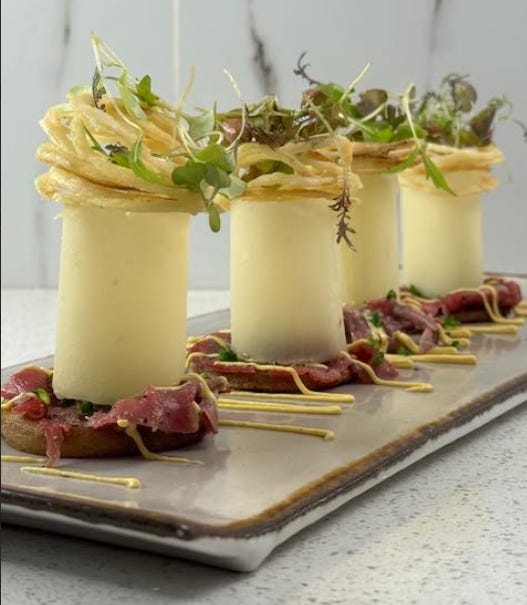
Smoked Foie Gras with Onion Puree
“Here we may reign secure, and, in my choice. To reign is worth ambition, though in Hell: Better to reign in Hell than serve in Heaven.”
Milton
C2-C4

The Cook made his first move.

An ambitious opening, full of daring and intent.

The Cook and The Pawn had embarked upon seemingly identical journeys, journeys
that appeared at the outset daunting, perhaps even futile. Their probable fate? Frustration, ineffectuality or defeat. For how could either of them seriously hope (that cruelly illusional state of mind) that their apparent common ambition, that of reaching the eighth rank and metamorphosing into something better, something other than what they were at the beginning, was remotely realistic?

Theirs had been a convenient relationship, one that temporarily shared the burdens of a common dream before collapsing under the weight of different expectations. Like huge tectonic plates, the partners’ ambitions had rubbed uneasily beside one another before cracks inevitably began appearing.

“Curse this damn ambition that drives you,” lamented The Pawn, shaking his head as he approached The Cook.

The familiar smell of simmering stocks, disinfectant and discarded scallop trimmings lent the kitchen an air of normality. The extraction fan hummed its usual melody. Conversation from his chefs was minimal, their volume respectful.

The Pawn visited the kitchen as little as possible, preferring the company of perceived friends draped in Gucci and Prada to the rag-clad lunatics encamped in the basement below. To him, the smell of luxury was vastly preferable to the smell of physical labour.
As he picked an imaginary speck from his suit, he continued. “It is a master that allows us neither rest nor peace, jeopardizing everything we’ve worked so hard for, whilst all the time I am forced to endure your increasingly ridiculous antics.”
Everyone agreed. The Cook’s behaviour had become increasingly irrational as he drove the whole machine furiously forward to a destination only he had the right to envisage.
Tap-tap-tap, as ingredients were chopped in preparation for the evening service.
“Your ingratitude seems so churlish,” replied The Cook with mock indignation. “You pretend to loath ambition, pretend to hate the exhausting, seemingly impossible demands it imposes, but hasn’t my ambition satisfied all your grubby desires?”
The Cook continued. “Think of the alternative. Think of the futility of your life’s toil without the prospect of some worthwhile achievement. Without ambition you would simply be a labourer and that you would equally despise.”
The Pawn listened with exasperation to the laments and ranting of The Cook. At twenty-five years old, both his arrogance and youthful inexperience were on full display.
The Pawn knew that his ambition was one of tangible ideas and realisable goals. He had started out in life with few advantages, yet had managed to propel himself, through his guile and hard work to an arguably better place. It might not be the stuff of legends, but it was surely a fine achievement. Wasn’t this something everyone could aspire to?
The Cook, by contrast, was still sufficiently immature to believe that any ambition, whose sole gratification stemmed from money and an elevated social status, was beyond contempt.
According to The Cook, ambition in any field represented great strides for humanity. It was Hegelian in its purposefulness and principle. The Cook’s ambition was beyond his control, he was simply obedient to the diktats of his inner voice. It was raw and idealistic, an imaginary ideal of one-dimensional movie heroes, of men with square jaws and earnest faces. It was Howard Roark or Gary Cooper. It was an ambition that was pitifully quixotic with elements of Grecian tragedy in its strive for perfection. It was also both tedious and tiresome for those within its proximity, as it required constant attention.
Lest we forget Schopenhauer’s observation:
“If we achieve what we strive for –which is the removal of nagging dissatisfaction – then we are confronted with the nullity and pointlessness of life.”
