


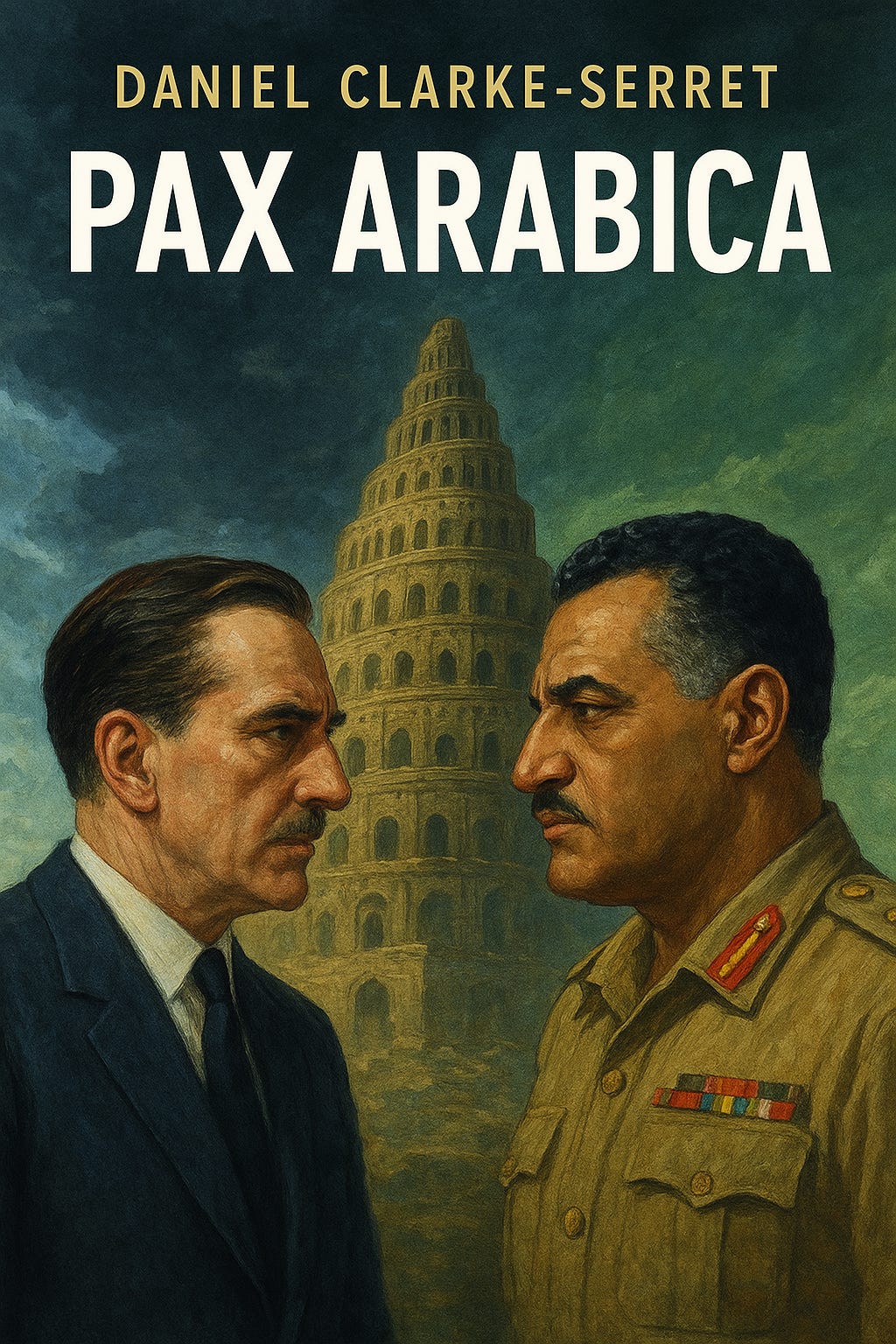
FOREWORD FROM DANIEL: Senior Kurdish official, government advisor and academic (and Guerre and Shalom Founder Member) Khaled Salih has written a wonderful review of Pax Arabica, my new book available exclusively for paid subscribers of Guerre and Shalom. Thank-you Khaled.
The paperback version of Pax Arabica can be found here on Amazon here:

“Some things you read don’t give you any new facts at all. They just give you a new pattern for understanding the facts you already have.”
— Robert M. Pirsig, Lila: An Inquiry into Morals
A Tale of Two Creeds
To comprehend the moral and ideological chasm that defines the modern Middle East, one must first confront two starkly opposing visions of humanity. One is a creed of systematic de-humanisation, of a lust for power that reduces human beings to objects of sectarian hatred and instruments of gratification. The other is a creed of defiant solidarity, a belief in a shared humanity so profound that its adherents will choose death over betrayal. The struggle between these two visions is the central, bloody drama of a cursed landscape called Middle East.
The first creed revealed its horrifying nature in the summer of 2014. When Islamic State terrorists stormed the Yazidi communities in Sinjar, they were not operating blindly. They carried lists detailing every household, identifying every family member, with a particular focus on young girls. This intimate knowledge was provided by their Arab Muslim neighbours, who facilitated the selection of their preferred prey: girls with blue eyes, blond hair, and light skin. The horror that followed was a direct consequence of an ideology that sees the “other” not as a neighbour, but as property. Sounds familiar? Think of thousand of workers from Gaza in Israel who returned with a different mission on October 7th, 2023.
“IN THE FALL OF 2014, a Saudi fighter for the Islamic State, ISIS, in al-Shaddadi, Syria, bought a female slave in the market, a 34-year-old Yazidi captive. He raped her over and over again. Why else do you buy a female slave? Then he purchased a second sex slave. This one was a 12-year-old girl. And suddenly the handcuffs of the Saudi fighter’s lust came off. Said the 34-year-old sex slave after she escaped, the ISIS fighter raped the 12-year-old youngster “for days on end despite heavy bleeding.” The 34-year-old escapee says with a mixture of despair and disgust, “He destroyed her body. She was badly infected. The fighter kept coming and asking me, ‘Why does she smell so bad?’ And I said, she has an infection on the inside, you need to take care of her.”
“‘She’s just a little girl,’ pleaded the 34-year-old. But the ISIS fighter answered: ‘No. She’s not a little girl. She’s a slave. And she knows exactly how to have sex.’’’ Then he added something vital: “And having sex with her pleases God [Allah].” So the fighter never provided medical care. Instead, he prostrated himself on the floor next to the adolescent girl’s bed, prayed to Allah, then mounted the child over and over again. Each time when he was finished, he laid himself out on the floor again and prayed. We do not know the end of the story. We do not know if Allah the merciful, Allah the compassionate ever answered the prayers with healing. And, frankly, we do not know if the fighter even bothered to pray for such a thing.”
— Quoted in Howard Bloom, 2016, The Muhammad Code.
This is the Middle East some have been propagating for hundreds of years.
But there is another creed, a bloody and essential rebuttal to this de-humanising sickness. It offers the only blueprint for a more humane future, and it was written not in a philosopher’s treatise but in the final, defiant act of the Christian villagers of Bedyal. This gripping story was re-told recently in a TV-interview by President Masoud Barzani. During Saddam Hussein’s Anfal genocide against the Kurds, these Christians, who lived as Barzanis in every civic and cultural sense, were rounded up with their Kurdish neighbours for extermination. At the last moment, an official offered them a cynical lifeline. Pointing out that they were Christians and therefore not technically part of the annihilation order, he told them, “You are not Barzanis, get out and go back.”
They were offered their lives in exchange for a simple declaration of sectarian difference. They refused. Their response was an act of communal fidelity so profound it rendered biological survival secondary to civic truth.
“No, we are Barzanis. Our life and our death are with the Barzanis.”
(For more on this village see here)
They chose fidelity to their community over the biology of survival, and their remains were later found among the martyrs with the Barzanis. A provocative new book, Pax Arabica, provides the intellectual framework to diagnose the sickness the Bedyal villagers died defying. It does not merely offer new facts; it provides a revolutionary new pattern for understanding this cursed landscape and presents a searing, unflinching vision for its dismantlement.
The Imperial Indictment
The strategic importance of Clarke-Serret’s Pax Arabica lies in its audacious central thesis, an act of intellectual demolition that recasts the modern history of the Middle East. It begins by highlighting the Prophet Isaiah’s call, the greatest descriptor of the region’s modern malaise:
“Woe unto them that call evil good, and good evil; that put darkness for light, and light for darkness.”
The book argues that the so-called “Arab World” is not a collection of oppressed post-colonial states but is, in fact, the most successful and insidious empire of all time. This “Arab Imperium,” it claims, has mastered a form of narrative inversion that compels its victims to recite its grievances.
The charge sheet against this empire is damning, exposing its true nature as a colonial power built on conquest and suppression.
Masters of Ethnic Cleansing The book directs our gaze to the ruins of Iraqi Jewry, a civilization that endured for 2,500 years and once constituted a third of Baghdad’s population, now reduced to a mere three souls. This was not a natural migration but a deliberate imperial policy of racist purge. Its success is enshrined in modern Iraqi citizenship law, which as recently as 2006 explicitly denied Jews the right to reclaim their stolen nationality—a clause that feels less like an injustice and more like a victor’s boast.
The Epicentre of Slavery and Genocide Through a blistering examination of Sudan, Pax Arabica claims that the Arab Empire perfected slavery and continues to practice it with racist indifference. The very name Sudan, we are told, is Arabic for “the Land of the Blacks,” a label applied not in celebration but as a designation for an outpost dedicated to kidnapping and enslaving black Africans. While the British Empire attempted to abolish this trade, the Arab elite resisted. This legacy finds its modern expression in the ongoing genocide against the Masalit people by the Janjaweed and its successor, the RSF—a horror that barely registers in a West obsessed with phantom colonialists.
The Architecture of Apartheid The true, functioning apartheid of the Middle East, the book argues, is not found where its enemies claim, but in the systemic and suffocating oppression of women. This female apartheid is illustrated through the poignant stories of “Leila” and “Loubna,” two culturally Arab women in France. Their experiences reveal how the tendrils of male domination, surveillance, and control extend far into the diaspora, creating a profound imprisonment even on the boulevards of a free Western nation.
Thus, the Arab Imperium built its dominion upon the ruins of civilizations like Iraqi Jewry and the bodies of the enslaved Masalit, perfecting the ultimate imperial art: forcing the world to stare at its finger while it hides its blood-stained hands.
The Imperial Toolkit
Beyond cataloging the empire’s crimes, Pax Arabica dissects the sophisticated methods of psychological and narrative warfare it employs to maintain its power and project its grievances onto its victims. This is a modern imperium that has mastered ideological subversion.
The book exposes the Palestinian movement as the “Vanguard of the Empire,” a claim substantiated with direct evidence from its own foundational texts. The 1968 PLO Charter states unequivocally:
Article 1: “Palestine is the homeland of the Arab Palestinian people; it is an indivisible part of the Arab homeland, and the Palestinian people are an integral part of the Arab nation.”
As the charter later clarifies, Palestinian identity is a temporary tool to be used “at the present stage of the struggle” for the ultimate goal of “Arab unity.” In this reading, Palestinianism is not a national liberation movement but an imperial spearhead aimed at the heart of Israel, the one indigenous, non-Arab nation-state that successfully defied the empire.
When secular pan-Arabism failed, another imperial weapon arose from its ashes: Islamism. Pax Arabica examines the work of Sayyid Qutb to frame Islamism not as a genuine liberation theology but as another totalitarian, universalist ideology. It is a “death cult” that promises freedom from earthly masters only to demand absolute submission to a far more tyrannical one—a ruinous alternative for those seeking an escape from their own imperial project’s failures.
The empire’s ultimate weapon, however, is the inversion of language. When the attack in the name of jihād, they label their invasion infitāh, opening —not colonialism, conquest, looting and raping. Long before the idea of “the White man’s burden” was born, these invaders euphemistically described their mission thus: an “invitation” to embrace their belief by converting, paying humiliation taxes (djizya) or elimination.
The vocabulary of human rights has been systematically hijacked, with terms like “genocide” and “apartheid” weaponised to accuse the empire’s victims of its own signature crimes. The analysis invokes the 18th-century philosopher David Hume, whose reading of the Al Coran led him to conclude that a word like “justice” in the Arabic context of his time had a tribal meaning—“beneficial or hurtful to the true believers”—that is “utterly incompatible with civilized society.” This linguistic warfare is devastatingly effective against a credulous West, where words are not yet understood as instruments of deception in a tribal calculus of honour and shame.
This masterful manipulation, however, succeeded only because of the active complicity and strategic incoherence of the West.
The Western Betrayal
Pax Arabica reserves some of its most scathing polemic for the West, whose failure to confront the Arab Empire is portrayed as a toxic cocktail of moral cowardice, historical ignorance, and cynical philosophy.
In a brilliant revisionist account of the 1956 Suez Crisis, British Prime Minister Anthony Eden is recast not as a fumbling imperialist but as a prescient statesman. Having resigned in protest against the appeasement of Mussolini, Eden correctly identified Gamal Abdel Nasser’s pan-Arabism as a new fascism, an ideological successor to the totalitarianisms he had fought in the 1930s. His attempt to halt this new menace was a defense of international order against a nascent Arab one. His defeat came at the hands of an America described as “the immature global power with the attention span of a smartphone addicted 6 year old,” a betrayal that unleashed Nasser’s imperial ambitions and fuelled decades of regional chaos.
The philosophical root of this modern Western appeasement is located in the bloodless calculus of utilitarianism. The book employs the “Sheriff counter example” to devastating effect. Israel is framed as the innocent man in the sheriff’s custody. The rioting townsfolk—the Arab world and its enablers in the West—demand his head. To achieve the “greatest good for the greatest number,” which translates to avoiding domestic terror and wider conflict, the utilitarian sheriff (the West) hands the innocent man over to the mob. This is the grim logic that repeatedly sacrifices a democratic ally to appease an imperial aggressor.
This profound vacuum of Western will and moral clarity has created a dangerous power vacuum, compelling the rise of a new, and reluctant, force for regional order.
A New Sheriff for a Lawless Landmass
After demolishing the Babel Terror of the Arab Imperium, Pax Arabica dedicates itself to prescribing a path toward a new, stable order—an “Eden” of sovereign nations.
The central conflict of the Middle East is thus reframed not as a dispute over territory, but as a clash of political philosophy: the struggle between Israel as a true nation-state and the surrounding Arab polities as nationless states—mere administrative districts, or “sanjaks,” of a wider, pan-Arab empire. The solution, therefore, is not more universalism, but true decolonisation. This requires dismantling the imperial fiction of a monolithic “Arab World” and fostering genuine national identities, as has begun in Morocco. Crucially, it means advocating for new nation-states for the region’s unprotected indigenous minorities, such as the Kurds and the Druze.
This political project must be underpinned by a clear-eyed understanding of what the book calls “the Psychology of Strength.” In the region’s tribal, honour-based societies, peace is not achieved through “reasonable” compromise, which is perceived as weakness. It is imposed through the establishment of deterrence via overwhelming and credible force, which alone generates the respect necessary for a stable order.
With America in strategic retreat, Israel is being forced to reluctantly assume the role of the “New Regional Sheriff.” In the “Wild West” of the Middle East, where international norms are flouted, Israel is compelled to enforce foundational laws—like nuclear non-proliferation—to prevent a descent into total chaos. This is not a role it seeks, but one that the failure of both the Arab world and the West has thrust upon it.
This new reality demands an uncompromising assessment of the book’s importance and the stark choices that lie ahead.
The Creed of Survival
In its brutal and brilliant diagnosis, Pax Arabica presents an intellectual framework that is nothing less than a controlled demolition of the West’s entire understanding of the Middle East. It unmasks the Arab Imperium as the region’s true colonial power, deconstructs its sophisticated weapons of narrative warfare, and indicts decades of Western appeasement as the product of moral cowardice and philosophical bankruptcy. The book argues that this combination of imperial aggression and Western weakness has forced the emergence of a new, reluctant regional order, demanding a radical re-evaluation of the path to peace.
We return to the sacrifice of the Bedyal villagers, who chose death over a life defined by the tyrant’s sectarian lies. Their choice was the ultimate defiance against the imperial creed of division. But this spirit of defiance, this creed of survival, is not just a historical anecdote. It is a living force.
We see this same spirit in the actions of the Yazidi community after their genocide. In the face of ISIS’s attempt to shatter their social fabric through mass rape and enslavement, the Baba Sheikh, the Yazidi spiritual leader, issued a critical dictum. He declared that the captured women—violated, sold, and brutalised—would be welcomed back into the faith and the community without shame or stigma.
This was a profound act of collective healing and strategic genius. By re-embracing the survivors, the Yazidi leadership directly defeated ISIS’s core intention: to break the spirit of an indigenous people and destroy them from within. They refused to let the enemy define the boundaries of their community or the worth of its members.
This is the path to dismantling the Babel Terror and building a new Eden. This is the vision of true decolonisation post-Pax Arabica. It is not a peace imposed by empires, but a peace built on the resilience and empowerment of indigenous peoples—Kurds, Druze, Yazidis, and others—who have survived relentless waves of genocidal ideologies.
There is a better future for the Middle East if we see and highlight the true energy of survival and thriving.
Buy Pax Arabica today by subscribing as paid to Guerre and Shalom:
Sources:
Howard Bloom, 2016, The Muhammad Code: How a Desert Prophet Gave You ISIS, al Qaeda, and Boko Haram—or How Muhammad Invented Jihad. Port Townsend, WA: Feral House
Robert M. Pirsig, 1991, Lila: An Inquiry into Morals. Bantam Books.
—, 20251109, “The Grace of Power: Masoud Barzani.”

Khaled Salih, 20251020, “Bear witness to cages of ideology: Nadia Murad and Eli Sharabi.”
—, 20250714, “When the wretched of Gaza returned. Death’s dream kingdom for six hours and one minute,” https://substack.com/@khaledsalih/p-168289930
PAX ARABICA by Daniel Clarke-Serret
Acknowledgements: With Thanks
Introduction: The time to change the narrative is now!
PART 1: BABEL
Chapter 1: On Arab Imperialism // Chapter 2: On the Vanguard //Chapter 3: On Dictatorial Oppression // Chapter 4: On Islamist “Freedom” // Chapter 5: On Islamist Misery // Chapter 6: On Arab Apartheid // Chapter 7: On Middle Eastern Minorities // Chapter 8: On the Masters of Ethnic Cleansing // Chapter 9: On Genocide, Slavery and Racist Indifference //Chapter 10: On Unjust “Justice” and the Inversion of Language // Chapter 11: On Appeasement // Chapter 12: On the Man who stood against Pax Arabica
PART 2: EDEN
Chapter 13: On Nations, States and the Nation State // Chapter 14: On Sykes-Picot // Chapter 15: On Zionism and the duty to protect // Chapter 16: On the New Regional Sheriff // Chapter 17: On the Psychology of Strength // Chapter 18: On the Paradigm Shift // Chapter 19: On the Post-Imperial Two State Solution // Chapter 20: On the End of the Great Game
AFTERWORD by Khaled Salih: A Song of the Oppressor and the Parody of the Oppressed.
The paperback version of Pax Arabica be found on Amazon here:
:
Post-WWII silence about the decades of Arab League-Nazi alliance was due to the thirst for OIL for postwar reconstruction and development. Oil was a factor in 20th century wars. Pan-Arabism spread ethnic and linguistic hegemonic supremacy across thousands of miles, shoving Arabic and Arabian culture (especially as relates to girls and women) down dozens of indigenous tribal throats. As the British did with the Irish, who seem to forget that it’s now Arab states, not Israel, forcing foreign culture onto conquered peoples. This continues today in Africa and now Europe. The Hamas charter of 1988 (the one they mean) is filled with residual Nazi ideology and violence from that era of collaboration. shalom / salaam
From Ashok:
"As someone who has struggled to make sense of Islam, the Arab world, and the Muslim sensibility- ever since my parents moved to the Arab Gulf in 1971- this part of the world continues to perplex and worry me.
In 1989, when I criticized India’s banning of Salman Rushdie’s Satanic Verses (as well as Khomeini’s Fatwa against the author), the secular, liberal establishment of my city, Bangalore, effectively boycotted me. In their eyes, Muslims in India were an exceptionally protected minority and any criticism of them would not just embolden the Hindu Right wing but would be an attack on ‘secularism’ itself. Years later the Progressive Left in the West, would similarly adopt Islam and Muslims as deserving of special concern, consideration and protection- even from democratic norms and laws that this group found ‘offensive’.
In the past decade or so, my concerns about (i) Arab states and their illiberalism and authoritarianism, (ii) The average Muslim’s intolerance of free speech and criticism, and (iii) the collective inability of Muslim’s to engage in self-reflection have made me question whether there can ever be real peace between the Muslim world and the West. I question also whether Muslims who live in the West have the capacity to integrate, assimilate or even be loyal to their Western passports- after all the Muslim’s primary loyalty is to the global ummah (Muslim brotherhood), not to the state.
I am looking forward to reading Pax Arabica carefully in the hope that Daniel Clarke Serret can provide me some insights."