



This week, as part of the anniversary of the Farhud, we have been focusing on the rise of fascist movements from 1930s Britain to 1940s Baghdad and the fragile place of Jews in even in their most important cities. We’ve even questioned the future of Jews in today’s New York.

Yet (non-Hitlerite) fascism isn’t just, or even particularly, about antisemitism. As I’ve argued in my piece about Mosley, the defining link between fascism in all its iterations is extreme-modernism: the desire to throw away the old and bring in the new. Nowhere is this more evident than in the matter of architecture, where fascist-inspired modernism is everywhere to be seen —a blight on the landscape and a mark of 20th Century hell that’s still with us to this day. If it had been up to Le Corbusier, Paris would have been demolished and all beauty would have been extinguished from the Earth.

Eric McIntyre is an essayist based in New York and his (unfortunately only metaphorical) demolition of Le Corbusier is a must-read. We thank him for his fine contribution.

I should say, as an aside, that democracy activist Deep Sharma will be continuing the fascism theme with a bold article about “fascism in India”. This is sure to cause fireworks among certain Indian readers, so if you strongly believe that the Modi government is a pillar of democracy, then I am very willing to publish a counter viewpoint so long as its well-written and argued.
Anyway, I now leave you with Eric’s magnificent ‘take-down’ of the modern architecture. - Daniel Clarke-Serret (editor)
Sign up as paid subscriber for access to all our serialised books and the full archive:
“A Century of Ugly Architecture” by Eric McIntyre
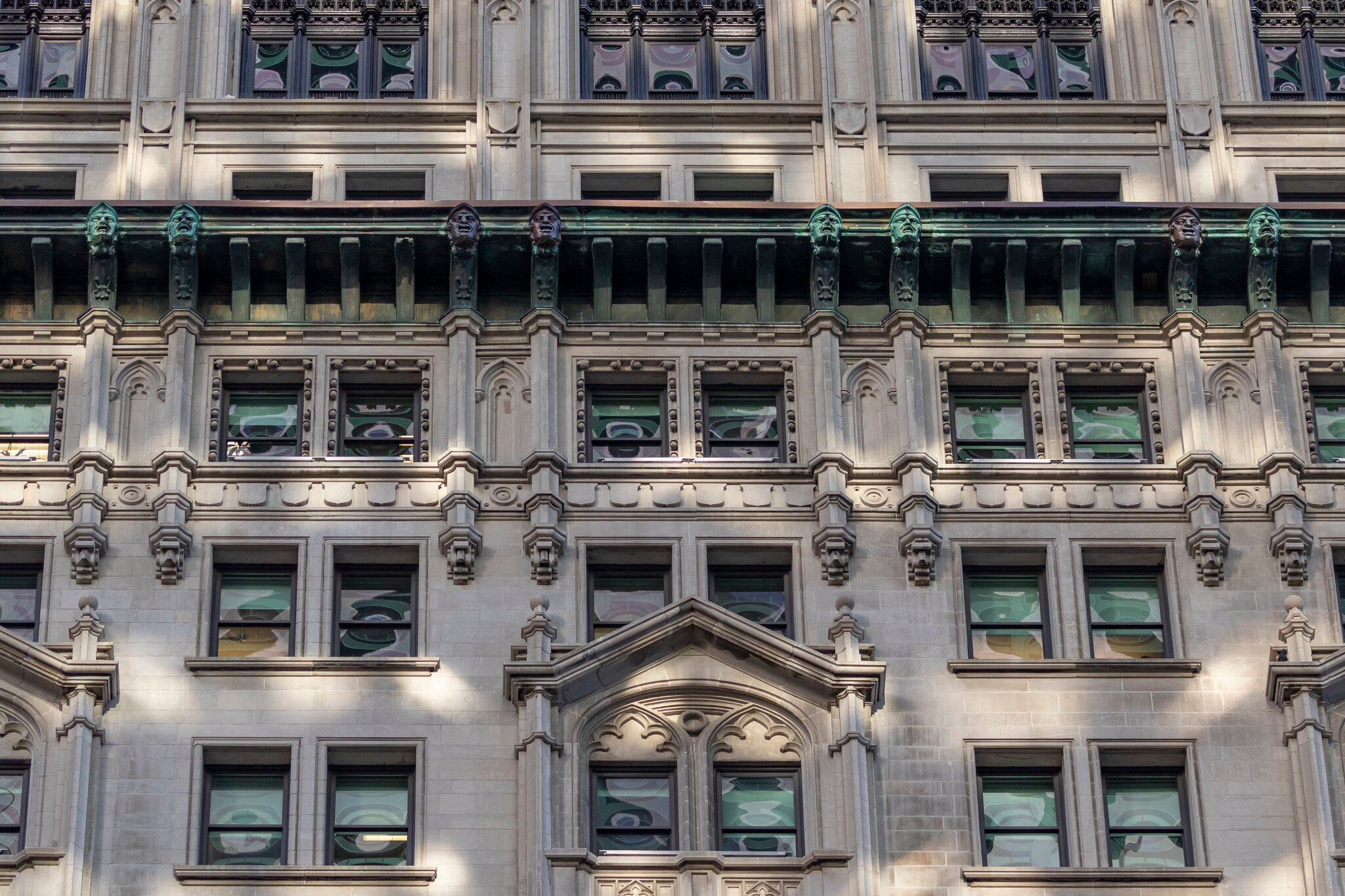
On the way to and from working at an office tower in lower Manhattan, it is not uncommon to find a tourist or passerby standing to marvel at the design, which is the work of an architect called Francis Kimball, built in 1907. The place is not famous or iconic and does not draw crowds, so there are never too many gawkers to cause a nuisance. Plenty of buildings from the period in the area are more beautiful, but every so often a few people happen upon it by accident, gape for a few moments and maybe take photos. This happens day to day, unless the weather is unpleasant.
Adorning the tower are winged gargoyles, parapets, stained-glass windows, and corbels with various stone faces carved into them. The first time I saw all of those exquisite details and endless more, my reaction was similar to others; I stood quietly with eyes wide in wonder for a few seconds. It looks like the sort of place where Batman could be lurking on a ledge at night to glare at miscreants below, while lightning strikes. Then, something else caught me by surprise.
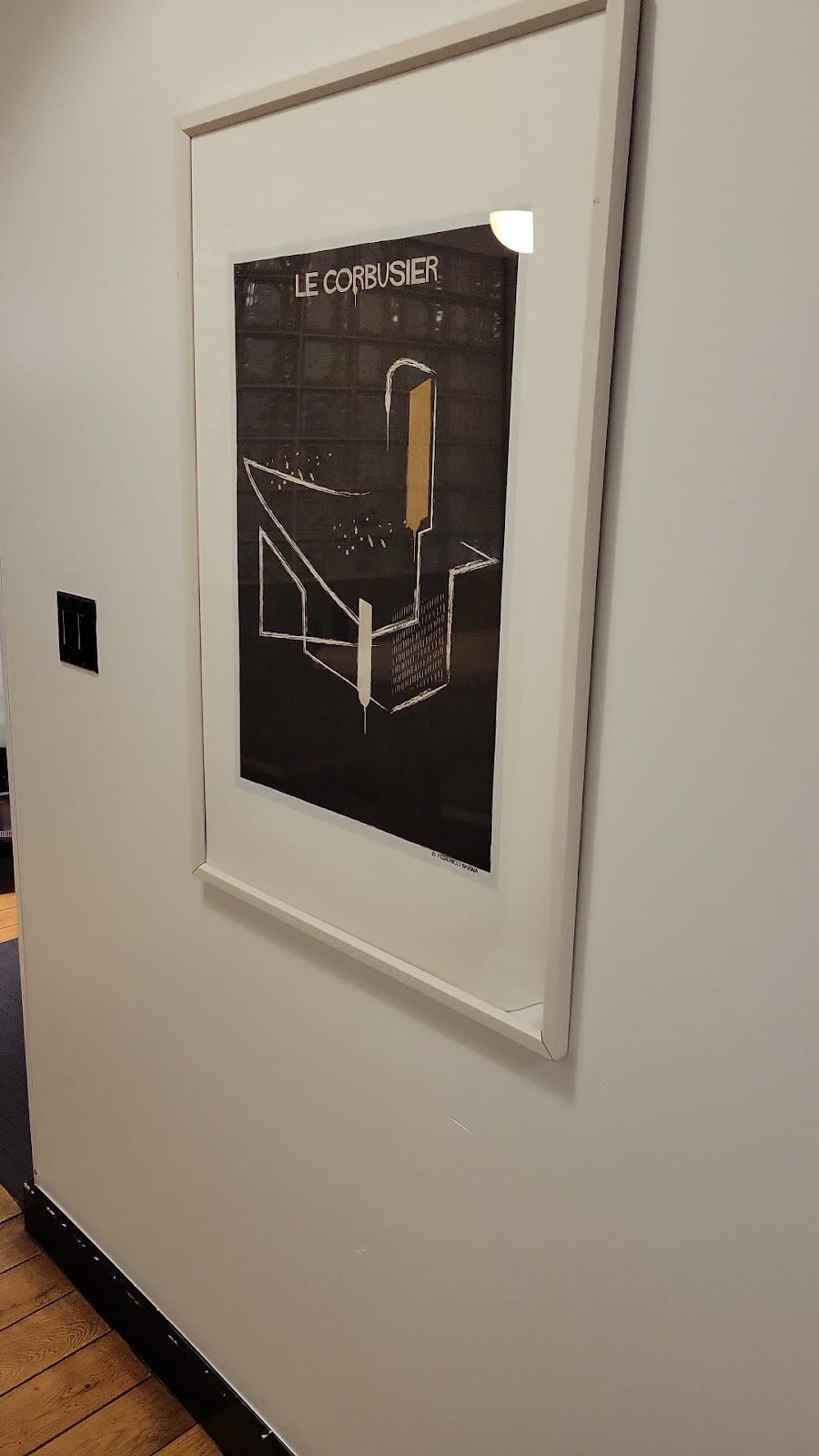
Framed on an interior hallway inside this neo-Gothic masterpiece is a poster. Across the top, in large print, is the name of an extremely influential architect and evangelizer — one who is known for despising and scheming to demolish buildings exactly like the one where the poster hangs. However, that isn’t the worst failing of the man who is honored on the poster.
There are plenty of compelling arguments about influential people in history whose otherwise admirable or redeeming qualities contrast with some awful relationship to either fascism or communism. Those who were drawn to both fascism and communism — a still vast and even more instructive set — could theoretically possess some laudable qualities, or so it can be argued. But vanishingly few among this set have literally made formal proposals to complete projects glorifying both the Nazi and Soviet regimes and been rejected by both because of their poor taste.
At least one man fits the description, however. He is just the sort of person to cause any opponent of “cancel culture” to start rehearsing their arguments all over again, if only to feel sanity return. Surely, if he does not deserve cancellation, then nobody does.
Indeed, even the Hitler and Stalin regimes had enough sense to rebuff the advances of the cartoon supervillain imitator whose name is now somehow admired enough to be framed on a wall poster. That wicked name — Le Corbusier — is a pseudonym, French for “keeper of crows,” a vocation suitable perhaps to some associate of the Joker. Most supervillains adopt pseudonyms, after all, and it was not only in his capacity as an architect (with no formal training, as an aside) that the man originally known as Charles-Édouard Jeanneret publicly evangelized for monstrosity.
Although he never donned a crow costume or lived in a secret lair, he did find spare time (and this is actually true) to be an amateur advisor to a eugenics organization, to pen at least one article opposing the presence of Jews in European cities, to attend fascist rallies, and to publish his writings approving of the German and Italian varieties of fascism. After failed proposals to the Vichy regime and a rejected design for the “Palace of Soviets” in Moscow, Stalin’s own disapproval of the architect was reconsidered by successor Soviet dictators, who fanatically endorsed all the design principles synonymous with his name and they are now visible everywhere the Soviets imposed their will. In fact, the Soviet state newspaper, Pravda, called him “the greatest master” of modern architecture. Luckily for me I’m not very superstitious, otherwise the mere utterance of the man’s name (no less than a poster celebrating it!) would seem like a curse meant to cast a pox on my house.
Le Corbusier’s single diabolical mission in life was to destroy the most beautiful things in the world and replace them with the most hideous things, though he didn’t see it that way. In his first published book on architecture in 1923, Vers une Architecture (Towards an Architecture), he explains that, “decoration is of a sensorial and elementary order, as is color, and is suited to simple races, peasants and savages.” Thus, in the “new age,” each person would reside in “a machine for living” devoid of “sensorial” things like color and decoration. It is very much worth reading the entire collection of essays cover-to-cover to fully comprehend the abysmal depths of the man’s raving lunacy, especially now that all the democracies that fought a cold war against Soviet dictators are now packed with the handiwork of the man’s legions of devoted followers and descendent schism sects.
The only humanizing feature of the style is a proclivity for parks and roof-top gardens. He is, despite himself, a human being after all — all too human — and his high-minded intentions are just believable, even amidst the total chaos and confusion of the book. Unfortunately, his parks and gardens offer only views of his own revolting horrors because he makes no accommodation for anything else within the sweeping, panoramic scope of his city-destroying urban planning, leaving nowhere to escape. His park designs themselves are also unattractive. Indeed, the countless parks today built in his style are especially notable for the absence of people visiting them, as compared to parks borrowing from, say, the English garden style, like Central Park in New York City.
According to the “Plan Voisin,” not even the most sinister supervillain plot he masterminded, Le Corbusier would have bulldozed half of Paris to replace its dazzling elegance with eighteen identical towering self-parodies of ghoulishness in which to stack his “machines for living,” although he inexplicably failed to record any maniacal cackle to menacingly announce the scheme. A smaller, parroted version conceived by his acolytes was instead built in a suburb called “The Silent City” and, during occupation, the Nazis recognized it (this is not a joke) as a great design for a concentration camp — a thought not unknown to many observers of the general style — repurposing the project under the name of camp Drancy.
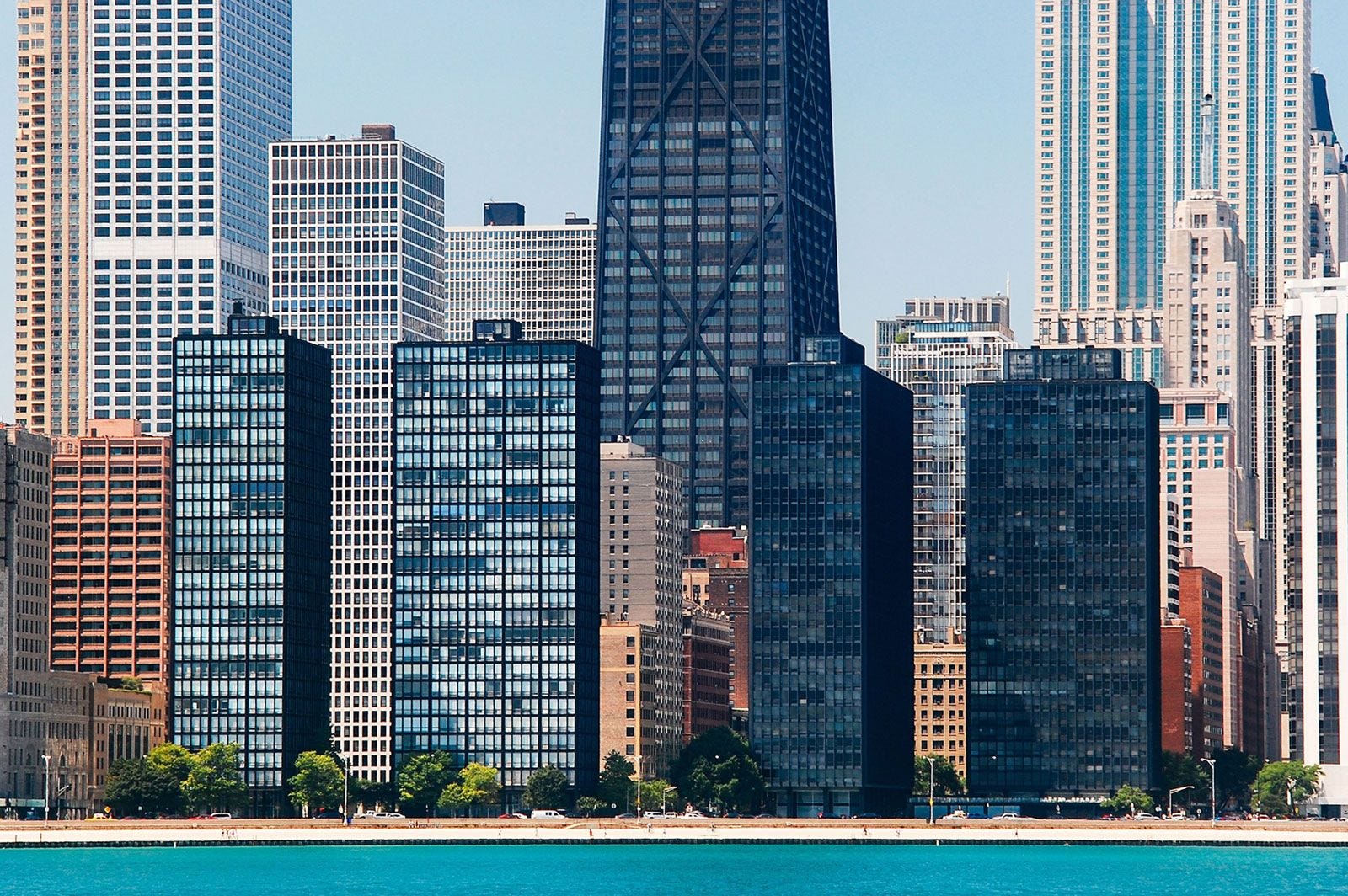
If he could have, Le Corbusier would have disfigured or wiped off the map many other cities. (And the International Style is now famous everywhere for completely disregarding all regional traditions or vernaculars in design, parasitizing the distinctiveness of old neighborhoods, and transforming the individuality of all cities into the same monotonous glass and concrete, like the Borg or some other hostile alien species assimilating every world where it spreads). For example, he planned to level all of Addis Ababa, the capital of Ethiopia, to build a Blade Runner–like dystopia for Mussolini and do the same in Algiers for the Nazi-Vichy-regime-era of French colonists there, not to mention his plans for historic Moscow, Stockholm, Rio de Janeiro, Buenos Aires and others.
Separating the art from the artist is not so simple with Le Corbusier. The “art” is extremely political and the politics are troubling:
The house will no longer be an archaic entity… the object of the devotion on which the cult of the family… has so long been concentrated.
…
Eradicate from your mind any hard and fast conceptions… look at the question from an objective and critical angle, and you will inevitably arrive at the “House-Tool,” the mass-production house, available for everyone, incomparably healthier than the old kind (and morally so too) and beautiful in the same sense that the working tools… are beautiful.
…
But it is essential to create the right state of mind for living in mass-production houses. [Emphasis original]
All that he dismissed in his incoherent manifesto, everything that people naturally find charming, or expressive of a sense of home, is redefined as ugly, lowly, “mere decoration” to be cleared away. Thereby, he fruitlessly tries to reshape human nature’s immutable need for a place to feel at home into a rigid mold fit for some new mutilated creature, judged superior by him, that will live in his “machines” and appreciate his genius, walking around ushering the “new age” all over the place, like toys in a demented model of Shangri-la.
Those unconverted to his mission merely have “eyes that do not see,” as he phrases it messianically. If one could look past the simple fact that Le Corbusier never knew a tyrannical dictator whom he did not admire and with whom he did not seek employment, that would not negate his utopian (which is to say totalitarian) goal inherent in the “art” itself and inseparable from its deepest nature. His style is the perfect physical embodiment of agony and malaise buried beneath quiet alienation.
It is impossible to imagine George Orwell’s 1984 without Le Corbusier’s style of “architecture” as the set of every torture chamber. What torturer would prefer a Beaux-Arts or art deco room over the International Style for doing the job? Beautiful decorations do not serve to torment, unless the torturer wants to deface beauty as part of the torture — perhaps, to demand that Winston Smith agree to Le Corbusier’s manifesto by having him smash the place to bits? At least Paris was largely spared Le Corbusier’s bulldozer, to my bottomless gratitude, but across the street from where I first discovered his poster is a murder scene in New York City:
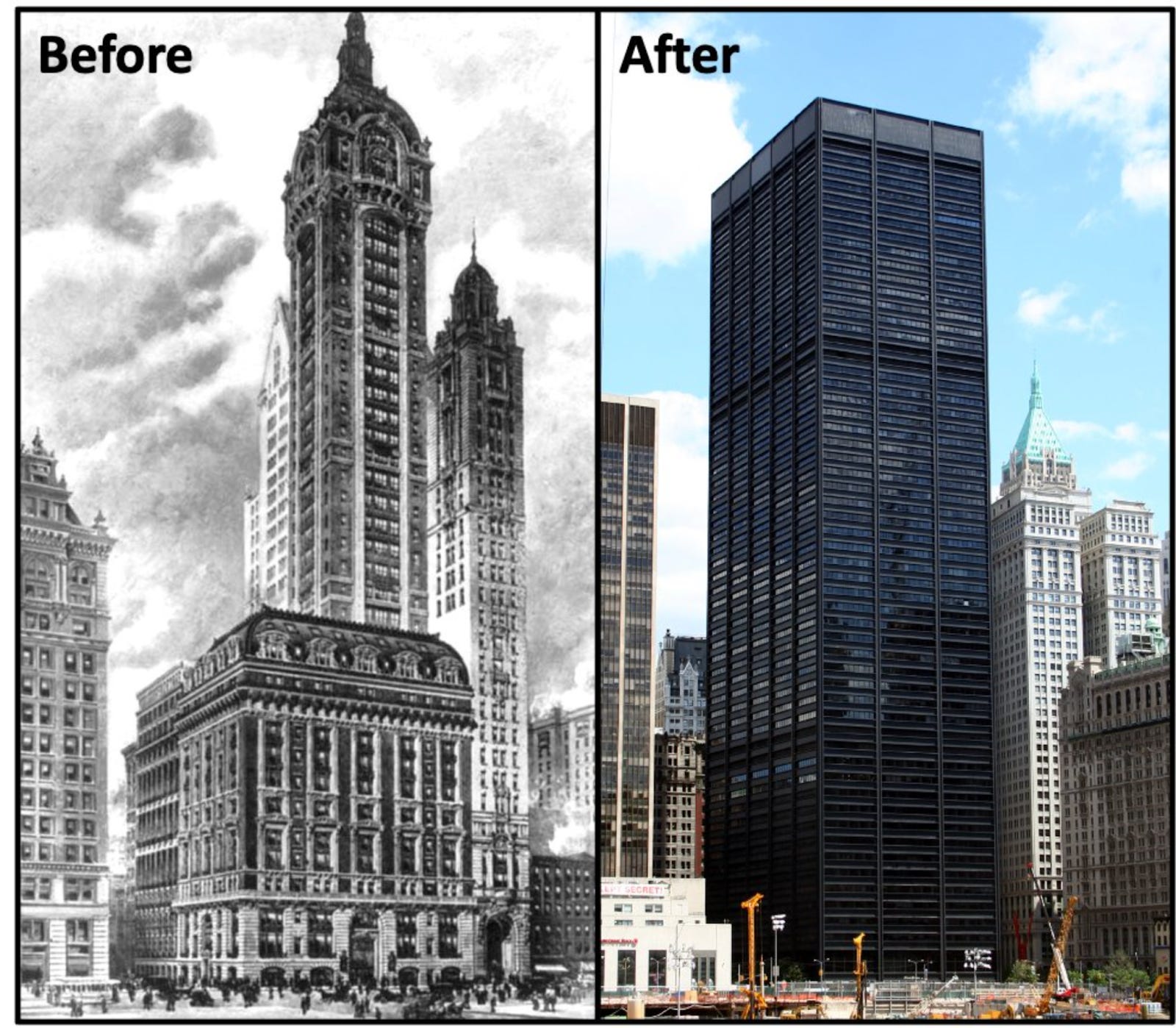
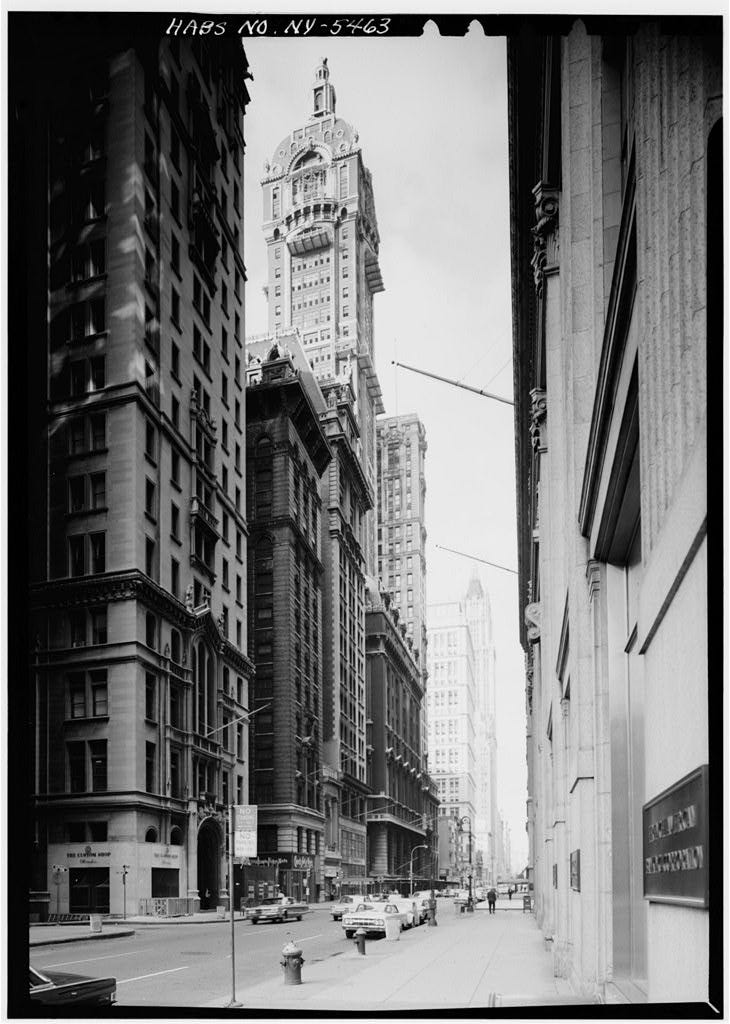
Where there was once a soaring colossal burst of beauty beaming out from the glorious Beaux-Arts facades of the Singer Tower, designed by Ernest Flag, completed in 1908, and the Romanesque Revival arches of the adjacent City Investing Building, whose architect adds a unique drama to this story, revealed soon, now there is only one drab deadening black monolith called One Liberty Plaza, designed by Gordon Bunshaft, finished in 1973. Any layperson who is dying to understand, “how did this happen?” can learn the story by reading an interview with Gordon Bunshaft, who explained:
Le Corbusier, in my opinion, was the person who created worldwide modern architecture as a standard through his books… Le Corbusier is the main teacher… Everything that every young architect did was influenced by Le Corbusier, period. Mies didn’t publish as early as Le Corbusier and also Mies didn’t blossom really until he came to this country. Mies was the Mondrian of architecture, and Le Corbusier was the Picasso.
